

 Step Back


 Language


![{$text['mgr_red1']}](../tng_placered.jpg) Cottingham 2 10a
Cottingham 2 10a
Concerning the Beadsworth family in Leicester: Part 1
by Alan D Craxford, Janice Binley, Roger Buxton and Jamie Ramshaw
With contributions from Chris Blenkarn
Introduction
Other articles within the website which relate to particular aspects of this story are noted within square brackets in the text. Links to these articles can be found in the table towards the bottom of column 2
This article, which is a continuation of "A History of the Beadsworth Family - Part 1, Origins" [Article A.], follows the progress of one of the branches of that family from its roots in Uppingham, Rutland and the neighbouring villages of Drayton and Bringhurst in Leicestershire from the early part of the nineteenth century to the middle years of the twentieth century. It concentrates on the offspring of Isaac Beadsworth, who was the youngest son of William Beadsworth and Alice Sumpter. As described in the previous article, William and Alice had six other children, the story of eldest son Anthony and his progeny appears elsewhere. As in the previous articles, research into this family is bedevilled by the many ways in which the family's surname is entered into historical documents. For simplicity the version given above will be used throughout the narrative, although on occasions examples where alternative spellings for the same person may be given in parenthesis as points of interest.
The family of Isaac Beadsworth and Sophia Wise

William Beadsworth married Alice Sumpter in the village of Bringhurst on October 20th 1797. Their seven known children were baptised there or in the hamlet of Drayton in the fourteen years between 1798 and 1812. Nothing is known of their family life but it seems most likely that they would have been employed as agricultural labourers or in the activities supporting farming. Isaac was the youngest of four sons and three daughters, although one daughter, Hannah, only appears as an entry in the parish baptism records and most likely perished in infancy or childhood.

St Margaret's Church (2)
As a young man, Isaac made the journey 20 miles westwards to Leicester. It appears he set himself up in the town as a local blacksmith. He met Sophia Wise who had also moved to Leicester from Nassington, a village near Peterborough, where she was born in 1812. The couple married on Tuesday May 20th 1834 at St Margaret's Church close to the centre of the town. They made their first home in Archdeacon Lane in the Belgrave Gate district.
The medieval town of Leicester was enclosed on three sides by walls which ran roughly along the line of Sanvey Gate to the north, Church and Gallowtree Gate to the east and Millstone Lane to the south. The western boundary was the river Soar.

Typical Archdeacon Court
During the nineteenth century, there had been a rapid expansion of housing and factories in Leicester which had transformed the medieval market town into an industrial city. Its population in 1831 was 38,904 which grew in the 70 years to 1901 to 211,579, much of which went to power the demands of the hosiery and boot and shoe trades. To accommodate these workers, cheap and poorly constructed cottages were "in-fill" built into courtyards behind or in the garden spaces of existing buildings. These overcrowded areas were concentrated in the city centre, particularly in and around Belgrave Gate, Sanvey Gate and Wharf Street. The cramped cottages were accessed through dark narrow passages from the main road, lacked sunlight and had poor ventilation. They only had shared and grossly inadequate sanitary arrangement. Toileting arrangements usually consisted of a communal soil bucket or ash pit which was emptied once a week by night soil men. Courts often shared space with small rudimentary slaughterhouses which had no proper drainage, refuse disposal or storage facilities [Further Reading: 1.]. Such was the situation in and around Archdeacon Lane.
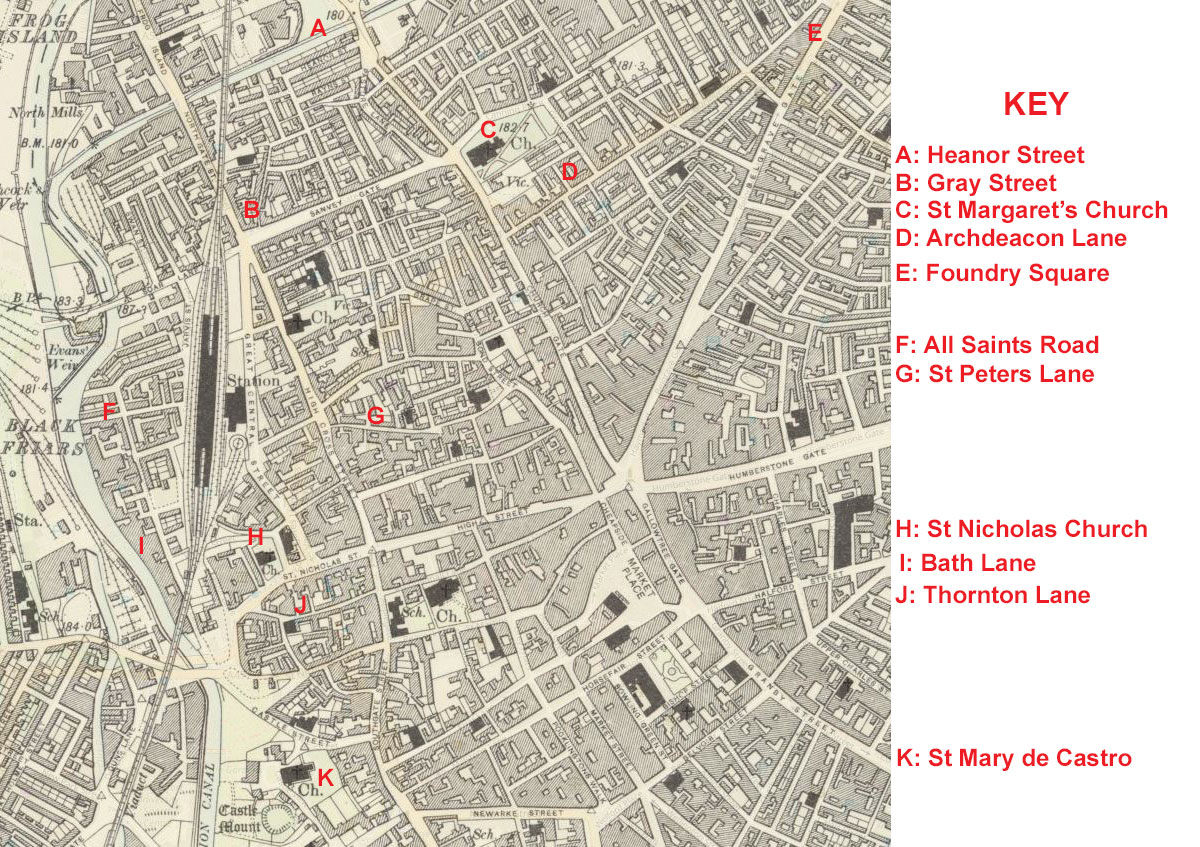
Isaac and Sophia's first child, a son they named Isaac, was born in the early months of 1837. However the toddler became ill and died with a severe chest infection when just 2 years old on October 13th 1839. He was buried in the churchyard of St Margaret's Church. Over the course of the next 17 years a further eight children arrived; three boys and five girls. At the time of the census of 1841, Sophia was tending her five month old baby and the couple were providing lodging of bookkeeper William Varnam. At the end of the decade, and perhaps under the pressure of the increasing size of the family, Isaac moved from Archdeacon Lane a mile of so east across Highcross Street to Bath Lane (labelled Bath Street in the 1861 census) in the Blackfriars district of the town. Much of this area was demolished in the 1880s to make way for the Great Central Railway Station. The Bath Lane accommodation was described in a later 1863 "For Sale" advertisement (3) as a "Messuage (a dwelling house with outbuildings and land assigned to its use) or tenement with a yard and garden lying behind it". Isaac established his trade there. The family moved again a few hundred yards across St Nicholas Street, settling in Thornton Lane at the beginning of the 1860s. Further moves followed, always in the same area of the town, first to Lawrence Street and then finally to Court B on All Saints Road.
Isaac was taken ill in November 1879 and was admitted to the Leicester Infirmary. He died there on November 17th 1879. He was buried in Plot 1465 of Section C of Leicester's Welford Road Cemetery. Sophia lived on in Court B for another 17 years. For a time she was accompanied by her oldest son, Isaac and by her nephew William (her youngest son's boy). She died in May 1896 and was buried in Welford Road Cemetery alongside her husband on May 28th 1896.


Left: Welford Road Cemetery: an engraving from about 1850 (4), Right: Welford Road Cemetery today (5)
Isaac (1840 - 1919)

Leicester Union Workhouse (7)
Sophia was about six months pregnant when her small boy, Isaac, died. She was delivered of another son in December 1837. The couple named him Isaac after his dead brother. Isaac never married but followed the moves of his parents until 1861 when he was working as a weaver. He had a minor brush with the law when he was summoned with his brother Joseph for trespassing in search of conies (rabbits whose skins were used for fur) on private land in 1866. They appeared before the Borough Police Court and were fined 46s. (forty six shillings) with the option of one month's imprisonment (6).
Then Isaac's history is distinctly vague for a period of over 20 years. When he was next documented in 1891, he was working as an iron foundry labourer and had moved into 1, Court B. He lived with his mother until her demise in 1896. After her death he had several admissions to the Leicester Union Workhouse in Sparkenhoe Street including the date of the census of 1901. His last recorded discharge from their care was July 7th 1902. He spent some time lodging with his younger brother William prior to the first World War. He was admitted to the Leicester Royal Infirmary where he died towards the end of November 1919. He was buried in Plot 1869 of Section N of the Welford Road Cemetery on December 2nd 1919.
Joseph (1844 - 1922)
Isaac and Sophia's next son, Joseph, was born in the summer of 1843. He was barely 20 years old when he married Margaret Ann Goddard. During their married life, she was to undergo 13 pregnancies over a 21 year period. Their story will be picked up in a later article [Article C.]).
Eliza (1845 - 1923) and Sarah (1848 - 1888)
Next the couple had two daughters just over two years apart. The first, Eliza, was born in the autumn of 1845. She was followed by Sarah who was born in the early months of 1848. The pair lived at home with their parents until the early 1860s. Eliza became a factory worker whilst Sarah was employed as an elastic winder.
Eliza and Frederick Mee
Eliza was the first to marry. Her husband, Frederick Mee, was born in Loughborough and was a shoe maker. The service took place at All Saints Church in High Cross Street on September 7th 1865. Sister Sarah was one of the witnesses. The couple settled in Thorpe Street, a cul de sac off Braunstone Gate in the west end of the town. They had four children, sons Storer (born 1865), Frederick (1867) and Albert (1871) and daughter Florence (1870). Albert only lived for about one year, dying of convulsions on May 10th 1872. He was buried in plot 496 of Section N of Welford Road Cemetery on May 14th 1872. Their married life was not to last. Frederick had become increasingly ill with phthisis (pulmonary tuberculosis) for a period of two years. In January 1873 he had an acute flare up with severe haemoptysis (coughing up blood) and he died on January 17th 1873, barely 28 years old. He was buried in Plot 1412 of Section N of Welford Road Cemetery. Eliza moved with her three children to be with her now widowed mother in 1881.


Left: All Saints Church, High Cross Street (8), Right: St Peter's Church, Highfields (9)
Sarah and Frederick Swailes
In her late teens, Sarah had the misfortune to get pregnant. The baby was stillborn. The event is recorded in an entry in the annals of Welford Road Cemetery on July 10th 1867. Sarah married somewhat later to iron moulder Frederick Swailes at St Peter's Church, Highfields on December 27th 1875. They settled close by her parents at number 5 Court D, All Saints Road. They were destined not to have any children. It seems Sarah had been increasingly unwell during 1888 with abdominal disomfort and abnormal bleeding. Sarah died on September 11th 1888 and was buried in Plot 1465 of Section C of Welford Road Cemetery. The registered caused of her death wsa "Cancer of the womb for 5 months".
Eliza and Frederick Swailes

All Saints Church, Wigston Magna (14)
Only just over a year later, Frederick Swailes married again, this time to Eliza Mee, his dead wife's sister. The wedding took place at All Saints, the Parish Church of Wigston Magna (10) on the southern outskirts of Leicester on November 11th 1889. This event in itself was highly irregular because marriage to a dead wife's sister was prohibited under Canon Law although it was not necessarily uncommon in the Victorian era. As church goers both parties would have been aware of the fact as tables of prohibited degrees of marriage could be found in every Prayer Book. Marriage with a deceased wife's sister was prohibited by statute passed in 1835. Historically it only became legal for a man to be able to marry his dead brother's widow in an Act of Partliament of 1907 (11, 12). It was not until 1921 that women were given reciprocal rights, probably because of the huge number of widows with young families left after the first World War (13). Examination of the Parish Register shows that Frederick and Eliza gave their place of residence as Bassett Street in Wigston Magna. It also showed that the witnesses to the marriage were her son Storer Mee and her now married daughter Florence Jarvis. All three, including Florence's husband Edward, were living in Bassett Street at the time of the 1891 census. In all probability Frederick and Eliza had used the young couple's home as a convenience address. The marriage was also conducted by Banns which meant that they did not require to have a qualifying period of residence in the parish before the wedding could take place [Further Reading: 2, 3.].
Initially after the marriage Frederick and Eliza returned to live next door to her mother at 2, Court. After Sophia died, they moved to Great Holme Street off King Richards Road in the west end of Leicester. Eliza died in the city in the autumn of 1923. Within months Frederick married again at the Leicester Register Office on February 28th 1924 to 77 year old widow Georgina Johnson (her maiden name was Hind). They moved into her small house in Earl Howe Terrace which opened onto Braunstone Gate. Frederick died in the early months of 1929. Georgina lived on alone until the late 1830s when she was admitted to Hillcrest Hospital (the old Swain Street Workhouse) where she died in the autumn of 1938.
Alice (1850 - 1922)
Isaac and Sophia's third daughter was born in 1850. She married and remained in the West End of Leicester for most of her life and raised a large family. Her story will be picked up later in this article.
William (1853 - 1922)
William was Isaac and Sophia's third son to survive into manhood. Several researchers have come to the conclusion that William Beadsworth was a bigamist. This is almost certainly not true. Bigamy is defined as the act of entering into a marriage with one person while still legally married to another. It was deemed an offence by both Church and state, punishable by a maximum term in prison of seven years (although statistics in the later 19th century show that the majority of convicted offenders served less than one year). Divorce was both expensive and difficult to obtain, particularly for the woman. Consequently after a marriage breakup new partners would most commonly live in a state of cohabitation. There is no evidence that William and Mary Makepeace were ever divorced: indeed Mary lived for 35 years after they parted. Similarly there is no evidence that William and Elizabeth Slater were ever married: again no evidence has been found to date to confirm Elizabeth's status when they got together or when and where she died [Further Reading: 2, 3.].
The unfolding story of William's two families will be told later in this article.
Mary (1855 - 1932)
Mary was Isaac and Sophia's penultimate daughter, born in 1855. She married John Henry Gill Headley, a baker, in 1873 and produced a large family. Their story will be picked up in a later article [Article C.]).
Betsy (1857 - 1939)

St Nicholas Church and Jewry Wall Leicester (15)
Last daughter Betsy was born on May 20th 1857. Before her twentieth birthday she married elastic band maker Edward Neale at St Nicholas Church, Leicester on July 16th 1876. Edward was the son of Isaac Neale and Sarah Atkins: Sarah's family had originated in Rearsby, a village on the road from Leicester to Melton Mowbray. The couple made their home in Braunstone Gate. Over the course of the next fifteen years Betsy presented him with four sons (Edward, 1878; Joseph, 1881; William, 1885 and George 1893) and three daughters (Clara, 1877; Minnie, 1883 and Lily, 1888).
For some time Edward had been suffering from ill health. This took the form of breathlessness, palpitations and swelling of the ankles. He died on July 11th 1895 at the relatively young age of 43 years. The cause of death was certified as heart disease and dropsy. His final address was in Ruding Road, the first street inside Narborough Road past Hinckley Road when leaving Braunstone Gate. He was buried in plot 657 of Section N in Welford Road Cemetery.

Church of the Martyrs (16)
After her husband's death, Betsy moved the family along Braunstone Gate to Thorpe Street. Daughter Clara left to get married on July 18th 1897 at the Church of the Martyrs on Westcotes Drive. Her husband was Thomas Blockly, a shoe finisher. Interestingly the couple gave their residence at the time of the marriage as Ruding Road. Son Edward, now a clicker, married Rose Hannah Meakin at the Church of St Mary de Castro on June 4th 1900. The remaining five childrren were with Betsy at the time of the census of 1901. Next son Joseph married shoe fitter Florence Holt at St Mary Magdalene Church, Knighton on August 28th 1909, leaving Betsy with her four youngest.
Another move followed and the 1911 census found her in Coventry Street which runs between King Richards Road and Hinckley Road, next but one and parallel to Great Holme Street. Next to wed was William, also working as a clicker. He married Sarah Ann Wardle at St Mary de Castro Church on September 28th 1912. Youngest daughter Lily married warehouseman John James Walker at St Paul's Church on August 2nd 1913. Youngest son George married Harriet Ashby in the closing months of 1914. In the early 1920s Betsy had moved again to New Park Street. Daughter Minnie, a wool spinner and now aged 41 years, married 50 year old miner James Dobson at St Mary de Castro Church on December 24th 1924. The Electoral Register for 1929 and 1930 shows Betsy living with William and Sarah Ann and Minnie Dobson in New Park Street.
Finally as she approached her late seventies, Betsy was noticeably incapacitated and moved in with George and Harriet, who by this time had added a daughter Minnie, to their house in Edward Road in the Clarendon Park district of the city. She died there at the age of 82 years and was buried in plot 1030 Section S of Welford Road Cemetery on October 18th 1939.
The family of Alice Beadsworth and James Gilbert

The Cathedral Church of St Martins (17)

St Paul's Church
Artist's impressions during construction
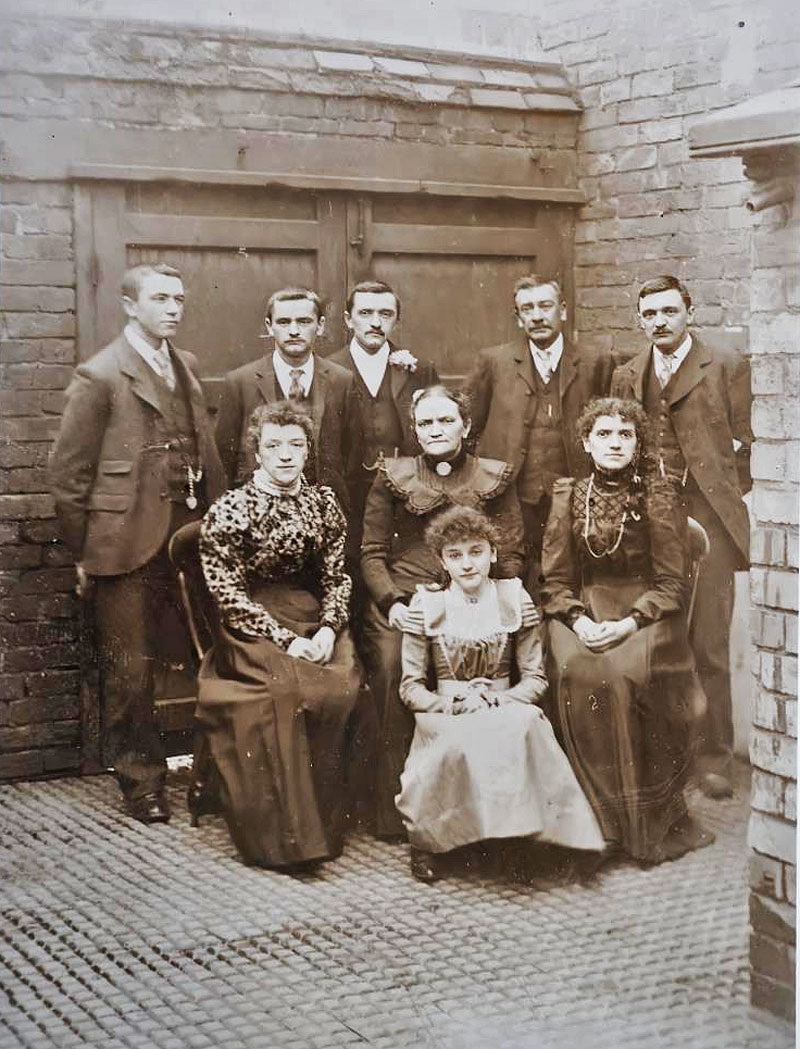
Third daughter Alice was born in the spring of 1850 while the family was still living in Bath Lane. At the age of 20 years she married James Henry Gilbert, also aged 20, at St Martin's Church (which was elevated to cathedral status in 1927 and which now houses the body of King Richard III) which stands in Peacock Lane. The couple were residing at an accommodation address in Silver Street. James was an elastic weaver, making the webbing used in braces, gloves and stocking tops (18). His father James was an elastic web manufacturer who, in 1871, had employed 8 men and 4 boys. Alice was working as a cook in the Gilbert household before the marriage. Family legend has it that James Henry married beneath himself, a belief probably sustained by the fact that of the signatories to the marriage certificate only James Henry signed his name. The remainder, Alice, the bride, and the witnesses (presumed to be) her brother William and sister Mary (Polly) could only make their mark. James was subsequently cut out of any inheritance from his father.
After the wedding Alice and James' first home was in Gray Street, a side street off Mill Lane. Almost immediately Alice became pregnant. A little girl they named Kate was born in March 1871. She was sickly from birth and only lived for three weeks, dying on March 31st. She was buried in plot 296 of Section N of Welford Road Cemetery on April 4th 1871. They did not remain there long and by 1874 they had moved to a house in Great Holme Street on the western side of the River Soar at the foot of King Richard's Road. In their first decade of married life, Alice had six children (James Arthur, 1872; Isaac, 1874; Ernest, 1876 - but who died the following year; Alice, 1877; Rose, 1878 and Ernest 1880). The two oldest boys and the two girls were all baptised at the recently built and consecrated St Paul's Church on the corner of Glenfield Road and Kirby Road (For more information about the church see "Growing up on Fosse Road North" [Article B.]. Two more children followed: Oliver (born in 1882 for a reason unknown in Nottingham; and Kate, named after their lost first born, in 1886). There is no dount that Alice was a formidable woman and her children thought the world of her.

The Black Horse (19)
In 1887, James undertook a major change of direction and took over the licence and the occupation of The Black Horse public house on the corner of Foxon Street and Braunstone Gate (19). This was where the family lived until the turn of the century. Sons James Arthur became a rivetter and Isaac a clicker, both in the shoe industry but continued to live at home.
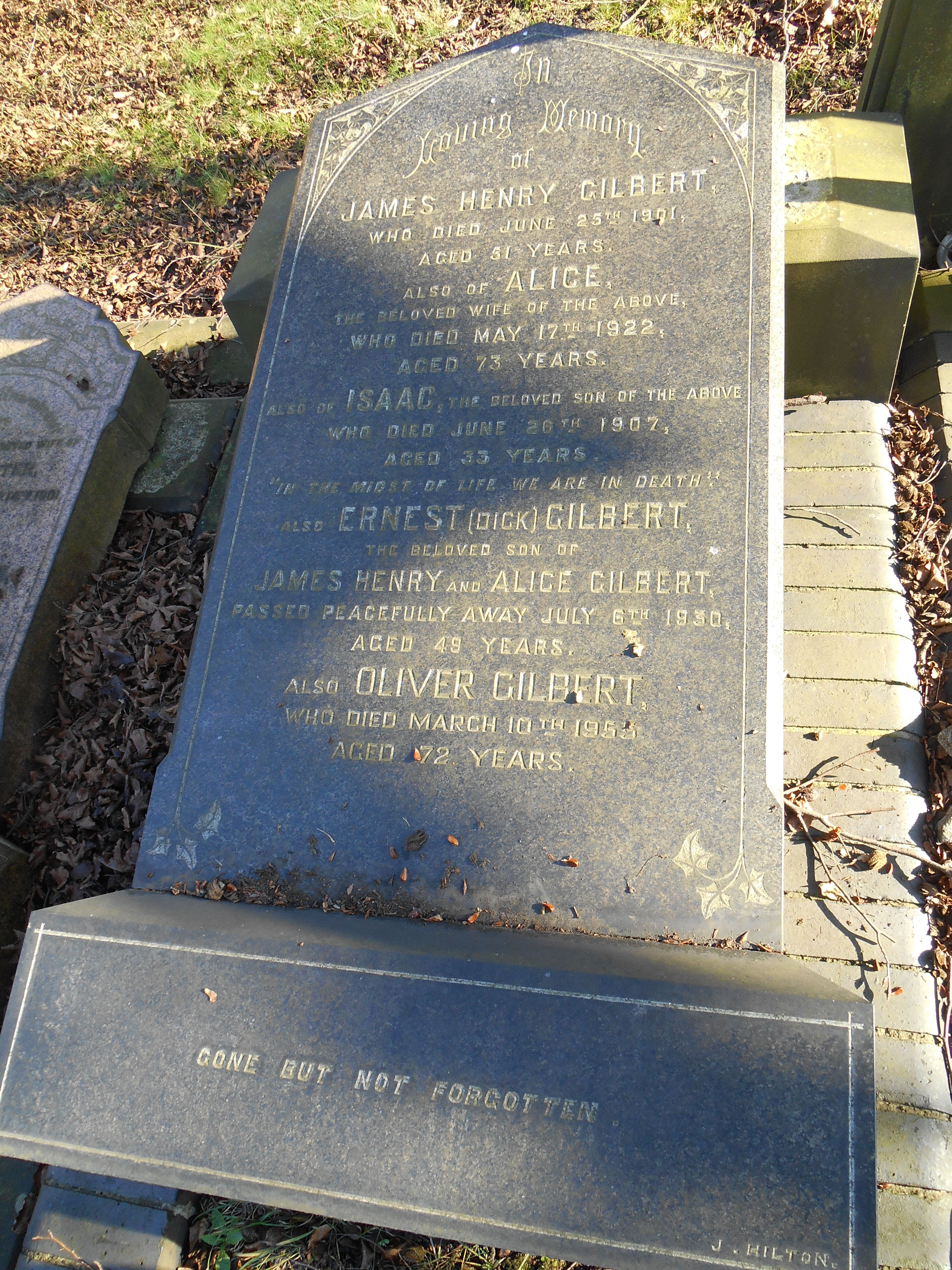
Family legend also suggests that James Henry drank the profits of the pub and probably drank himself to death. He died in June 1901 aged 51 years old, the cause of death being given as hepatitis and dropsy. Also of note, Alice could still only make her mark on James Henry's death certificate. James was buried in Plot 807 of Section M of Welford Road Cemetery on June 28th 1901. Son Isaac died and was buried alongside his father on July 1st 1907. Alice maintained the licence for the Black Horse and was assisted at the bar by her daughter. In due course Alice gave up the trade. In her later years she moved out to Somerville Road at the southern end of Narborough Road with her sons Ernest and Oliver. She died aged 72 years and was interred with her husband on May 22nd 1922. Ernest died and was buried with his parents on July 9th 1930. Oliver died on March 10th 1955 and is commemorated on the same headstone.
James Arthur (1872 - 1965)
Son James Arthur married Alice Spiers, a hosiery hand, at the Church of St Mary de Castro on April 6th 1896. The Spiers family lived in Foxon Street a few doors away from the Black Horse. James followed in his parents' footsteps and became the landlord of the Sir Charles Napier beer house on Causeway Lane where they made their home. The census of 1911 suggests that they brewed beer on the premises as James employed a brewer and pot man. The couple had no children but they did adopt a girl, Ida Phyllis Spiers, who was born in 1904. After the end of the first World War, he had retired from the licenced trade and James and Alice moved to 35 Aylestone Road. Alice died in May 1936 and was buried in plot 2537 of Section P of the Welford Road Cemetery. James continued to live in Aylestone Road. In 1939 he had housekeeper May Clarke and her daughter Elsie living with him. In the 1950s, his address had changed to 85 Aylestone Road where he died on September 24th 1965.
(I remember visiting James Arthur in his house in Aylestone Road which was opposite the Leicester Tigers Rugby Football ground. I should also say that James Arthur Gilbert was a very energetic man and became quite well off. They always had a maid at home (latterly a housekeeper) many of them coming from an orphanage, and at least one getting married from his house. He also entered local politics and was elected to the Board of Guardians. My aunt Nellie used to have a wonderful poster, now sadly lost, showing his photo and the caption "Plump for Gilbert", to encourage voters to vote him onto the Board of Guardians. He used to say that he might have become Lord Mayor but perhaps this was just bravado. He was also an early motorist; my mother and my aunt, as small girls, would go on holiday with him and his wife, I think to Skegness. Once he had to avoid another car along the narrow Lincolnshire lanes, and they ended up in the ditch with the two children sitting in the dickey seat! Despite all this he lived to the ripe old age of 93 having outlived all his younger siblings. [- R.B.])
Isaac (1874 - 1907)

1907 Minerva car (23)
Next son Isaac met his death in a tragic accident on June 26th 1907 (21, 22). He was a passenger in a Minerva motor car being driven by Henry Oliver (son of the boot manufacturers George Oliver and Sons of Charles Street). Also in the car was Isaac's friend Walter Higginson, a butcher who lived in Foxon Street. Travelling along Narborough Road in the evening the car was in collision with a woman riding a bicycle. The car braked hard and caught the kerb and one of the tyres burst and a rear wheel broke away causing the vehicle to overturn. Isaac was thrown over the front of the car, landing on the road and car struck him on the head. The other two occupants were seriously injured, including Higginson who still used crutches from a previous fracture of the femur. The cyclist was thrown off her bicycle and was also badly hurt. At an inquest three days later, Harry Oliver admitted that he was on the wrong side of the road on a dangerous bend. A verdict of accidental death was recorded and Oliver received a caution .
Please contact us
 If you have any questions or comments about the information on this site in general, or you have further information regarding this article, please Get in touch by leaving a message in our Guestbook. If you don't want the message to be added to the Guestbook, just say that in your text. We look forward to hearing from you.
Added - August 10th 2020
Revised and updated: October 1st 2020
The family of Alice Beadsworth and James Gilbert (Continued)
Alice (1877 - 1960)

St Mary de Castro and the Castle Gateway (24)
Daughter Alice married James Albert Weston, a rotary hand, at the Church of St Mary de Castro on July 5th 1903 with her brother Isaac and sister Rose acting as witnesses. James who was born about 1870 was a widower. His first wife, Henrietta, died in April 1902 and was buried in plot 28 of Sector T at Welford Road Cemetery. James and Alice made their home in Great Holme Street where they had a daughter they named Alice Madge on May 27th 1904 and a son, James Henry, born in 9th April 1906. (Son James Henry was an in patient at the Infection Diseases Hospital on Groby Road at the time of the census of 1911.) Tragedy struck when, at the age of 44, James died on June 19th 1910. He was buried three days later with his first wife in Welford Road Cemetery. Alice and her daughter, usually known as Madge, and son James Henry (Jimmy) stayed together. Jimmy married in 1932 but died in 1937 and was buried with his father in Welford Road Cemetery. Madge trained as a shorthand typist and became a bookkeeper. Before the second World War she and her mother had moved in with Alice's still single brother Oliver in Somerville Road out along the Narborough Road. Alice died on June 24th 1960 and was buried alongside her husband in Welford Road Cemetery, Madge lived on until 1994.
Rose (1878 - 1923); Ernest (1880 - 1930); Oliver (1882 - 1955)
James and Alice's next daughter Rose was baptised at St Paul's Church on October 16th 1878. When old enough she started working in the Black Horse as an assistant beer seller. She married Silas Joseph Abram at St John the Baptist Church, Knighton on Christmas Day 1912. They were to have two son: Isaac, born in 1915 and Silas born in January 1916. Sadly Siilas died within 24 hours of birth and was buried on January 10th 1916 in plot 1185 of Section P at Welford Road Cemetery. Silas took over the licence of the Black Horse and was still in post when Rose died there on December 23rd 1923. She was 45 years old. Silas lived on until the beginning of 1939.
The brothers Ernest (known to the family as Dick) and Oliver were born within two years of each other. In adulthood both went into the building trade. Neither of them married and both continued to live with their mother. Ernest was aged 49 years when he died and was interred in plot 807 of Section M at Welford Road Cemetery on July 9th 1930. Oliver died on March 10th 1955.
Kate (1886 - 1958)

Dane Street Avenue
Youngest daughter Kate probably met her future husband fabric trimmer Noel Garner in the Black Horse. They were married at the church of St Mary de Castro on August 2nd 1908, her brother Oliver and his sister Adelaide were on hand as witnesses. They initially lived in Dane Street Avenue. This was one of the narrow cul de sacs of housing which were infill built between streets in the West End of Leicester without road frontage and which were vigourously opposed by campaigners at the time [Further Reading: 1.].

The Avenue sprang from a path on the north side of Dane Street and comprised 20 dwellings. It was almost opposite to the house where her first cousin Joseph Headley had lived a few years before and almost next door to where Joseph's brother John Henry would settle in the next decade. Noel and Kate had two daughters (Vera, born on April 21st 1914 and Ellen (known as Nellie) on February 11th 1919). Noel worked as a fabric finisher at the Abbey Meadow Mills but they left Dane Street and this job after he contracted an illness. By 1920, the family had moved to Alfred Street in the Lee Street part of the city where Noel was the licensee of an off licence. There they stayed until the 1930s when Noel moved the family back to his native Fleckney, a village 9 miles south of Leicester. Ellen had to journey back into Leicester for some months until she was fourteen years of age to complete her schooling. Kate died and was buried in the village in the spring of 1958; Noel in the winter of 1973.
The families of William Beadsworth: (1) with Mary Makepeace
Isaac and Sophia's next son was born in the spring of 1862 while the family were still in residence in Thornton Lane. As soon as he was old enough he followed his brother into the trade, initially as a shoe finisher. This applied the finishing touches and polishing to the shoe or boot and was often carried out by the young or least skilled of the workforce. In the early 1870s William began a relationship with Mary Makepeace. She was the daughter of Edward Makepeace and Mary Ann Hodges who lived in Heanor Street which lies between Sanvey Gate and the canal. Like two of her sisters she was employed in a factory as an elastic spinner. Mary became pregnant during 1872 and gave birth to a son they named William on April 17th 1873. A month later the couple were married on May 18th at St Margaret's Church with William's sister Sarah acting as a witness. The couple had one more son: Arthur, born in the winter of 1876.
The marriage was not to last. By 1881 the family had split up. Mary had returned to her father's house in Heanor Street taking young Arthur with him. Son William (known now as Willie) was lodging with Sophia, his recently widowed grandmother. Mary remained with her father, who died in 1910 in Heanor Street into the new century. She died in the winter of 1916. As far as is known she never saw her husband William again.
William (1873 - 1954)
Mary's son William married Rose Elizabeth Mary Ann Slater at St Margaret's Church on Jun 16th 1894. They initially settled in South Wigston and then in Glan Parva, Leicestershire. Rose died in 1936. William lived on until February 1st 1954.Arthur (1876 - 1917)

St Mary's Church, Hinckley (26)
Her son Arthur signed up for a short service enlistment with the 3rd Battalion, the Leicestershire Regiment on May 23rd 1892. Physically he was noted to be 5 feet 3½ inches tall, weighing 8 stones 1 pound with hazel eyes, brown hair and a fresh complexion. After a brief spell he was transferred to the Kings Royal Rifle Corps on September 3rd 1892 but was discharged on September 29th 1892 "in consequence of his having made a misstatement as to his age on attestation".

In 1893 Arthur started a career as a footballer playing amongst others for Hinckley Town, Leicester Fosse, Coventry City and Manchester United. The local newspapers had many reports of his exploits on the field. He also played cricket for the local team Hinckley South End. He married Polly Farmer at St Mary's Church, Hinckley in Leicestershire on November 11th 1895 and settled in the town. They were to have four children (one son, born November 12th 1898, and three daughters) although one girl died at just over a year old in 1915. At the outbreak of hostilities Arthur enlisted with the 7th Battalion, the Leicestershire Regiment on September 2nd 1914. He declared he was just short of his 34th birthday but was in fact almost 38 years old. He was shipped out to France of September 29th 1915. He was promoted to the rank of Acting Colour Sergeant. In October 1917 the Battalion was involved in fierce fighting near Ypres during the German retreat to the Hindenburg Line. Arthur was caught in a gas attack during a counter offensive and died in hospital on October 9th 1917. He was buried at the Wimereux Communal Cemtery in Sector VI Row C Grave 19. Wimereux is a town on the French coast a few miles north of Boulogne [Further Reading: 4.]. At almost the same time his 20 year old son, Private Leslie Beadsworth enlisted with the Welsh Regiment. He was wounded in action on the front line in September 1917.
Leslie Beadsworth did return home to Hinckley at the end of the war. He married Sybil Harris in the town in 1920. Leslie became a window cleaner while Sybil worked as a shirt and pant overlocker in a hosiery factory. By 1939 they had three children and were settled in Beaumont Avenue in Hinckley. Polly, Arthur's widow died in the latte months of 1939. Leslie was caught drinking after hours at the Lime Kiln in Hinckley on November 19th 1941. He was fined £1 at the Hinckley Magistrates Court (27)
The families of William Beadsworth: (2) with Elizabeth Slater
After the marriage break up it is not known where William was living at the time of the 1881 census. Records are somewhat confused by him varying between Beadsworth and Beedsworth during this time. However it appears that he took up with a woman by the name of Elizabeth Slater who, in later documents, stated that she was born in Northampton. Extensive research had failed to identify her conclusively. Was Slater her maiden name? Indeed that was the name given in the registers for her offsping. There was an Eliza Slater living in the St Margaret's district of Leicester in the 1860s, the daughter of a cabinet maker who originally came from Preston, a village near Uppingham. Had she been previously married to someone named Slater before she met William? It is certainly not unknown for a previously married woman to enter her married surname when registering her children by a second man? A shoe finisher in Leicester, William Ebenezer Slater who married Elizabeth Kilby in 1872 was the father of Rose Elizabeth Slater, born in November 1872, mentioned above.

Leicester Town Hall (29)
William appears in the 1891 census as Alexander Bosworth, a boot and shoe maker, born in London with a wife Elizabeth and two young daughters living in Saffron Lane, Aylestone. By 1892, three children were attributed to the couple. There was a move to Water Street, South Wigston in the middle of that decade. In February 1895 he appeared in Court at Leicester Town Hall charged with stealing a terrier dog. He was ordered to pay costs (28). In the late 1890s they lived for a time in St Peters Lane which was a side street off Highcross Street opposite the Great Central Station. By 1901 William had settled his new family into a house on the corner of Shelley Street and Knighton Fields Road in the south of Leicester. He was still working as a shoe finisher. A decade later William had moved again, half a mile west to Sheridan Street. He had also changed his job and become a keeper of a grocery shop with Elizabeth assisting him. At the time of the 1911 census William's older brother Isaac was lodging with them. It is particularly noteworthy the way in which William filled in that census return. He stated that he and Elizabeth had been married for 40 years and that they had had six children of which four had died. Sometime around the beginning of the first World War, William moved back along Knighton Fields Road to a house in Wordsworth Road. He died there in the spring of 1922 and was buried in Plot 469 of Section S of the Welford Road Cemetery on May 27th 1922.
Sophia (1883 - )
The first child on record was Sophia, described as being born in Colchester, although there is no corresponding entry in the birth indexes to that effect. She attended the Board School in South Wigston from September 3rd 1895 when her date of birth was given as April 15th 1883. She was living in Shelley Street at the turn of the century following which she disappears from the records.
Kate (1888 - 1900)
Their next daughter was born on February 10th 1888 and named Kate Slater Beedsworth. She, with Sophia, are the two girls living with "Alexander" and Elizabeth in Saffron Lane in 1891. She attended the Board School in Wigston Magna alongside her older sister. She died in St Peters Lane on November 26th 1900. The diagnosis given was "chorea; endocarditis" (this probably represents Sydenham's Chorea, a neurological disorder of childhood resulting from infection with Group A beta-haemolytic streptococci - the cause of rheumatic fever (30)). She was buried in plot 784 of Section H in Welford Road Cemetery on November 29th 1900.
Alick (1891 - 1918)
Alick Slater Beedsworth was registered in the Blaby District of Leicestershire which covered the Aylestone area of the town in the spring of 1891. On February 5th 1908, Alick (as Alec Beadsworth) signed his attestation form for 6 years service with the Army Reserve (Special Reservists). He joined the 3rd Battalion, the Leicestershhire Reiment as Private 9907. He declared himself to be 18 years and 9 months old. Physical examination showed him to be 5 feet 3 inches tall, weighing 7 stones 8 pounds. He had grey eyes and black hair. He attended for special training in musketry and then for annual camps. He had two minor infractions recorded on his conduct sheet in 1908 (being drunk and overstaying a pass) but otherwise his character was entered as "very good". He was promoted to corporal in 1911 and to sergeant on July 29th 1912. His term finished in February 1914 when he was said to be living in Underhill Street, a narrow side street off Upper Conduit Street close to the London Road railway station. On his discharge record was noted under next of kin his parents, William and Elizabeth, who were now living in Glen Parva to the south of Leicester and also listed William (Mary's son) as his brother. A wife is not mentioned.
Alick married Mabel Allen in Leicester in the fourth quarter of 1912. They had two daughters: Elizabeth, born in early 1913 and Mabel who followed in the autumn of 1914. At the outbreak of the first World War Alick re-enlisted and was shipped out to France on October 5th 1914. He joined "D" Company of the the 2nd Battalion, the Leicestershire Regiment as Private 11410. The Battalion was in action from March 1915 in Neuve Chapelle and again in May at the Battle of Festubert. Alick was part of a nighttime advance into No Man's Land on May 15th 1915. Alick did not survive and was presumed killed in the attack. His body was never recovered. He is commemorated on Panel 11 of the Le Touret Memorial in the Pas de Calais. It lies alongside the Bethune to Armentieres Road at the eastern end of the Le Touret Military Cemetery. Paradoxically the Commonwealth War Graves commemoration lists him only as "Son of Mrs Elizabeth Beadsworth, 119 Wordsworth Road, Leicester". At the end of the war a War Gratuity was paid to the relatives of men who had fought. The UK Army Register of Soldiers' Effects for Alick shows that a gratuity of £5 was paid in stages, split between his wife Mabel and his mother Elizabeth (31) [Further Reading: 4.].

The Le Touret Memorial (32)
It is not known what became of his widow. To date no record of her death has been discovered and she does not appear in the 1939 Register. Her daughter Mabel married Joseph Henry Chawner on June 16th 1934. By the outbreak of the second World War they were living in Gooding Avenue in the Braunstone Park area of the west end of Leicester.
Kate (1904 - 1998)

Kate's Wedding (33)
Last known child of William and Elizabeth, Kate, was born on January 21st 1904. She was present in 1911 in Sheridan Street. In July 1927 Kate married William Robert Simms at St John the Baptish Church, Clarendon Park. The Banns were called in his parish of St George's and hers in the parish of St John's.
By 1939 they were living in Wordsworth Road just four doors away from where her father had died. William was a foreman paint; Kate worked as an overlocker of pullovers and pants in a hosiery factory. After the second World War, they moved to Braunstone Avenue in the west end of the city. William died there on September 18th 1976. Kate was to marry again in the spring of 1891 to Edward Hill. She died aged 94 in the winter of 1998.
Acknowledgements
The authors would like to express their thanks for the help, comments and suggestions from the following in the construction of this article: Jackie Marsh for her photographs taken working with The Friends of Welford Road Cemetery; Gregory Drozdz, The Hinckley Museum for permission to use photographs of Arthur Beadsworth; Barry Lount, the "Pub History Project - Leicester" website.
Further Reading

1

2

3
The book covers
1: "The Slums Of Leicester": (2009), The Breedon Books Publishing Company Limited, Derby. ISBN: 978-1-85983-724-5
For an authoritative guide to the housing stock and the overcrowding which ensued in Victorian Leicester we recommend "The Slums Of Leicester" by Ned Newitt. The book comprises a photographic record of the dreadful conditions which prevailed in many of the streets and courtyards in the centre of the city prior to the slum clearances of the 1930s and early 1970s. It is illustrated with contemporary accounts of residents who lived there. Contemporary commentators of the time such as physician Dr John Barclay (1864) and Unitarian Joseph Dare (1872) were particularly critical of the trend for "inter-buildings springing up between the streets as originally laid out. Rows of small scamped tenements approached from the main street, through narrow arched passages, choke up what ought to be gardens and breathing spaces".
2: "Marriage Law for Genealogists: the definitive guide. Revised Second Edition" (2016) Takeway Publishing, Kenilworth, Warwickshire. ISBN 978-0-9931896-2-3.
3. "The Changing Legal Regulation of Cohabitation: From Fornication to Family, 1600-2010" (2012) Cambridge University Press. ISBN 978-1-107-53630-2.
Rebecca Probert is Professor of Family Law at the Law School at the University of Exeter. She has written a number of textbooks and books of general interest including the ones listed here. They are indispensable guides for everyone tracing the marriages of their English and Welsh ancestors between 1600 and the twentieth century. They explains why, how, when and where people in past centuries did and did not get married. The points of interest raised in this article are two fold. The first examines the validity of the two marriages involving the Beadsworth sisters, Eliza and Sarah. The second looks at the subject of bigamy and whether it applies to the relationships of William Beadsworth. Rebecca had been able to offer help and advice on legal aspects of several issues raised in our pages for which we are always grateful.

4: Cottingham and Middleton, Northamptonshire Soldiers 1914-1918 Christine Blenkarn has developed and devoted a website to honour the men of Cottingham and Middleton who served in the Great War. It notes principally those who were killed in action while doing so (as was the case of Alick Slater Beadsworth and of Arthur Beadsworth). It also looks at the impact on their families and the local community.
Links to the articles mentioned in the text are in italic capitals below:
Article A: It all began in Uppingham A history of the Beadsworth family - Part 1: Origins
Article B: St Paul's Church and surroundings Growing up on Fosse Road North, Leicester
Article C: The families of Joseph and Mary (Polly) Concerning the Beadsworth family in Leicester: Part 2
References
1. Family tree graphic: Freeware Graphics: Vintage Kin Design Studio, Australia
2. St Margaret's Church, Leicester: The Churches of Great Britain and Ireland. From an old print about 1900 in George Weston's collection.
3. To be sold by auction: Valuable Freehold Houses, The Friars, Leicester. Leicester Journal Page 1 June 5th 1863. The British Newspaper Archive; © The British Library Board.
4. "After life's fitful fever, city's great and good sleep in pleasant spot". Lithograph of Welford Road Cemetery about 1849 Leicester Mercury October 14th 2013
5. Photograph: Welford Road Cemetery, Leicester Friends of the Welford Road Cemetery, Leicester Ancestors
6. Trespass: Proceedings before the Borough Police: Leicester Journal Page 8. December 14th 1866. The British Newspaper Archive; © The British Library Board.
7. The workhouse in Leicester in Peter Higginbotham's web site The Workhouse
8. Photograph of All Saints Church, Leicester © Kris1973; Permission for use granted under the terms of the Creative Commons Attribution-Share Alike 4.0 Licence from Wikipedia, the free encyclopedia
9. Photograph: St Peter's Church Highfields from a photo set by and © Aiden McRae Thomson. Reproduced with permission.
10. The two churches of the Parish of Wigston Magna All Saints and St Wistan's The Church of England Parish of Wigston Magna
11. An explanation of The Deceased Wife's Sister's Marriage Act 1907 wikipedia, The Free Encyclopedia
12. Text of Deceased Wife's Sister's Marriage Act 1907 (7 Edw. 7, c. 47.) Pages 135 - 136 Simongatward.com
13. Deceased Brother's Widow's Marriage Bill 1921 (11 & 12 Geo. 5. c. 24) Hansard June 28th 1921
14. Photograph of All Saints Church, Wigston Magna © TheBertiebee; Permission for use granted under the terms of the Creative Commons Attribution-Share Alike 4.0 Licence from Wikipedia, the free encyclopedia
15. Photograph of St Nicholas Church and Jewry Wall, Leicester © NotFromUtrecht; Permission for use granted under the terms of the Creative Commons Attribution-Share Alike 3.0 Unported Licence from Wikipedia, the free encyclopedia
16. Church of the Martyrs, Leicester © George Weston The Churches of Britain and Ireland: Leicester © Steve Bulman
17. Photograph of The Cathedral Church of St Martins, Leicester from Leicestershire & Rutland Churches
18. The City of Leicester Elastic web manufacture Pages 326 - 327, BHO: British History Online
19. Black Horse, Braunstone Gate / Foxon Street. Pub History Project, Leicester
20. Photograph by Jackie Marsh: Gilbert Family Headstone Friends of Welford Road Cemetery, Leicester. at Find A Grave: Reproduced with permission
21. Motor Car Fatality Near Narborough: A Remarkable Accident in Leicester Daily Post Page 2 June 28th 1907The British Newspaper Archive; © The British Library Board.
22. Leicestershire Motor Fatality, Driver Cautioned. Report of Inquest held at Enderby, Leicestershire on June 28th 1907. Nottingham Evening Post Page 6 June 29th 1907The British Newspaper Archive; © The British Library Board.
23. Minerva 4 cylinder 24 hp car 1907, Illustration from a 1907 Minerva brochure
24. Photograph: St Mary de Castro Church, Leicester History, tourist information and nearby accommodation British Express
25. Photograph: Arthur Beadsworth © Hinckley & District Museum, Reproduced with permission
26. Photograph of St Mary's Church, Hinckley © jsurridge; Permission for use granted under the terms of the Creative Commons Attribution-Share Alike 4.0 Licence from Wikipedia, the free encyclopedia
27. "20 Minutes Late": Leslie Beadsworth fined by magistrates: Leicester Chronicle Page 11 December 27th 1941 The British Newspaper Archive; © The British Library Board.
28. A Question of Ownership: In Court at Leicester Town Hall Leicester Chronicle Page 3 February 23rd 1895 The British Newspaper Archive; © The British Library Board.
29. Photograph of Leicester Town Hall © zaphad1; Permission for use granted under the terms of the Creative Commons Attribution 2.0 Generic Licence from Wikipedia, the free encyclopedia
30. Sydenham Chorea information oage: The National Institute of Neurological Disorders and Stroke.
31. War Gratuity for Alec Beadsworth Entry 354729 UK Army Registers of Soldier's Effects, 1901 - 1929
32. Photograph of Le Touret Memorial © Vvet; Permission for use granted under the terms of the GNU Free Documentation Licence from Wikipedia, the free encyclopedia
33. "A Pretty Wedding": Photograph of the Sims-Beadworth Wedding at St. John's: Leicester Chronicle Page 24 August 6th 1927 The British Newspaper Archive; © The British Library Board.
Translate this page:



Internet Beacon Diamond Site - 2010
© The Craxford Family Genealogy Magazine and individual copyright holders.Edited and maintained by Alan D. Craxford 2005 - 2026. All rights reserved. Contents may not be reproduced without permission.
You are not authorized to add this page or any images from this page to Ancestry.com (or its subsidiaries) or other fee-paying sites without our express permission and then, if given, only by including our copyright and a URL link to the web site.


 Computers, Poole, Dorset, UK
 UK Web Hosting