

 Step Back


 Language


![{$text['mgr_red1']}](../tng_placered.jpg) Cottingham 2 11a
Cottingham 2 11a
Following the Beadsworth family in Cottingham - Part 2a: William
by Alan D Craxford and Janice Binley
With contributions from Chris Blenkarn
Introduction
Other articles within the website which relate to particular aspects of this story are noted within square brackets in the text. Links to these articles can be found in the table towards the bottom of column 2
This article is a continuation of "Following the Beadsworth family to Cottingham: Part 1 Arrival" [Article A.] which followed the progress of Anthony Beesworth and his wife Elizabeth Hipwell from his roots in the village Bringhurst in Leicestershire at the beginning of the nineteenth century and his family after he had settled in the viilage of Cottingham, Northamptonshire. This current article concentrates on their eldest son William. As in the previous articles, research into this family, and that of his wife Priscilla, is bedevilled by the many ways in which the family's surnames are entered into historical documents. For simplicity the version given in the title will be used throughout the narrative, although on occasions examples where alternative spellings for the same person may be given in parenthesis as points of interest.
The family of William Beesworth and Priscilla Readihough

Anthony Beesworth, who was born in Bringhurst Leicestershire, was 22 years old when he married Cottingham born Elizabeth Hipwell on November 22nd 1820 at the Church of St Mary Magdalene. She was probably a couple of years older than him. Their child, a son they named William, was born in the early months of the following year and was baptised at the same church on July 22nd 1821. By the time their family was complete, William had seen the arrival of five brothers and four sisters. The earliest known address (from the census return of 1841) for the family showed them living in Dag Lane (which later became known as School Lane). William had already become an agricultural labourer and was living in the household of farmer Thomas Peake, three doors along in Dag Lane.

St Mary Magdalene Church, Cottingham
William was to marry Priscilla Readyhough in Cottingham on December 21st 1848. His sister Ann and her future husband, Edward Binley stood as witnesses. It is not known when and where William and Priscilla met. She was the seventh of the eight daughters of Joseph Readyhough and Sarah West. The name of this family also varies wildly in the way that it appears in various documents over the years (Readyhoof; Readyhuff; Reddihoof; Reddyhoofe; Redehoof). The version used here is the one inscribed on the marriage record of this couple although the name is spelled Readyhoof consistently on the birth register for all of their children.. The family came from the village of Gretton, five miles north east of Cottingham. Two of Priscilla's sisters, Ann and Alice, had married into the Pridmore family which has featured in stories from Gretton [Article B.] William set up the family home in Dag Lane close to its junction with High Street, two doors away from Berry house where his aunt Sarah was living with her husband William Atkins [Article C.].
A son was born on September 30th 1849 which they named Joseph Readyhough but the infant died five days later. He had suffered fom convulsions from birth, Their first daughter, Sarah Elizabeth, was born on March 2nd 1851 and was baptised twelve days later. In that first decade Priscilla had another three sons and a daughter, Sadly their second son born on February 23rd 1863 and again baptised Joseph Readyhough died on May 14th the following year of acute pneumonia. He was buried on May 16th 1854. At the time of the census of 1861, William, Priscilla and their four surviving children were still living in Dag Lane. Their next door neighbours were Edward and Ann Binley and five children while just around the corner in Rockingham Road was William's brother Thomas with his wife Harriet and two daughters. Two more sons and two more daughters arrived during the 1860. Sometime that decade, perhaps under the pressure of the increasing size of the family, William made the move into a house in the High Street. Next door was David Tansley and his wife Elizabeth Peach who acted as the village midwife.
A final daughter was born in the spring of 1873 and registered as Emma Jane Readyhough. During the 1870s William made their final move into Corby Road. William died aged 78 years and was buried on October 4th 1902. Priscilla followed him in the winter of 1907.


Left: High Street including the Spread Eagle ; Right: Church Street, Cottingham
Sarah Elizabeth (1851 - 1938)
Their first daughter was born on March 2nd 1851 and baptised Sarah Elizabeth on March 14th 1851. By the time she was ten years old she was earning a few coppers for the household as a lace runner (someone who embroiders lace items). In the latter part of 1873 she became pregnant and in the summer of 1874 she gave birth to a son she named George Wright Beadsworth. In 1877 she married agricultural worker Solomon Oliver. He had been born in Bringhurst, Leicestershire, one of the home villages of Sarah's Beadsworth ancestors. As far as is known his mother's name was Martha. In 1871 he was lodging in Drayton with the Perkins family. After their wedding, they settled into a house in Blind Lane two doors away from the Royal George public house. By 1891 the family had moved into Barrack Yard, an enclosure of cottages off Blind Lane. Overall they were to have six children (Sarah, 1879; Ellen, 1880; Frederick, 1883; Florence Elizabeth 1885; Harry, 1889 amd Albert, 1892). Solomon remained on the land while Sarah became a tailoress working at the nearby clothing factory of Wallis and Linnell at the bottom of Rockingham Road. Solomon died at the age of 52 years and was buried in Cottingham churchyard in 1893.


Left: The old Wallis and Linnell clothing factory ; Right: The factory staff

Royal Field Artillery cap badge (2)
Daughter Sarah married ironstone labourer Lewis Marshall in 1902 and moved to Corby where they had three sons and four daughters. By 1911, Sarah was living in Corby Road with her three sons George, who was a groom, and Harry and Albert, both working as blast furnacemen. Their next door neighbours were Charles Crane, the widower of Sarah's sister Alice Rebecca and his three sons. Daughter Florence became a machinist at the clothing factory and for a time lodged with the family of Samuel Aldwinckle in Blind Lane. She married Charles Woollard in the spring of 1917. Youngest son Albert Oliver enlisted with the Northamptonshire Regiment at the outbreak of the first World War. He married May Archer in Chesterfield in the autumn of 1914. He became Driver 85015 with the Royal Field Artillery serving in both France and Egypt. His daughter Doris Oliver, born in 1923, married Walter Crane, one of the grandsons of Alice Rebecca Beadsworth and Charles Crane in 1949.

Warwickshire Regiment cap badge (3)
Son Frederick was born in the spring of 1882. He was destined to pursue a military career. He joined the Northamptonshire Militia in November 1900 and transferred to the 16th (Bedfordshire) Regiment of Foot. His service came to an end in 1911 but he re-enlisted in January 1915, this time with the 1st Battalion, the Warwickshire Regiment, fighting in the Ypres Salient in Flanders.


On April 22nd 1915 fierce fighting, including the use of gas by the Germans, broke out around the town of St Julien. An Allied counter attack took place on April 25th leading to heavy casualties. Frederick was killed in the action and his body was never found. He is commemorated on the Menin Gate at Ypres and on the Cottingham War Memorial. [Further Reading: 1.]
Sarah died in 1938 and was buried in Row B5 plot 68 of St Mary Magdalene Churchyard. Her daughter Ellen may have had health issues for many years. She was an in patient in hospital in Kettering in 1911. She remained unmarried and was noted to be incapacitated in her entry in the 1939 Register.
Alice Rebecca (1855 - 1905)
Alice Rebecca was born in the spring of 1855. She ultimately became a tailoress at the Cottingham clothing factory and married into the Crane family. Her story will be picked up later in the article.
William (1857 - 1946)
William was born in 1857 and married into the Tansley family and moved to Nottingham. His progress too will be followed later in the article
Anthony (1860 - 1946)

All Saints Church, Polebrook (4)
William and Priscilla's fourth son was born on July 4th and baptised Anthony after his grandfather on July 22nd 1860. Like so many youngsters of the time, before he reached his teens he was deployed in the fields scaring birds from the crops. Sometime before 1880 he moved the 13 miles eastwards to Oundle. There he met Mary Ann Spencer who had been born in the nearby hamlet of Polebrook. They were married in the winter of 1880. Mary Ann was probably heavily pregnant at the time of the ceremony and a daughter they named Elizabeth Ann was born on January 21st 1881. They settled in Great Oakley, a village 7 miles due south of Cottingham.

St Michael's Church, Great Oakley (5)
The first decade appears to have passed peacefully enough. Mary Ann presented Anthony with five children (Elizabeth Ann, 1800; Alice Rebecca, 1882; Herbert Spencer, 1884; Annie, 1886 and Mary Margaret, 1889). The next decade turned into a nightmare. Mary Ann had another six pregnancies but all her babies died within weeks. A son, Percy William, was born in early 1892. He contracted what was diagnosed as "Cynanche trachealis" or Croup (also known as laryngotracheobronchitis: a common viral infection in children causing a rasping cough) from which he died on November 9th 1893. Mary Ann was already well into her next pregnancy when her son died. Whether it was cause and effect, but she went into premature labour on February 11th 1894. A boy they named Anthony survived for twelve hours. In the middle of the same year, they tried again and on March 11th 1895 a daughter, Mary Ann, was born. She was in poor condition from birth, suffering from convulsions. She died after 6 days on March 17th 1895. When Mary Ann became pregnant again for the eighth time a few months later it soon became clear that she was expecting twins. A boy, Albert Edward and a girl, Ethel Mary, were born in March 1896. They initially appeared to be developing satisfactorily. Unfortunately they both contracted whooping cough from one of the ever present epidemics which led to bronchopneumonia. Albert died on December 4th 1896; his sister Ethel one day later. Mary Ann became pregnant for the last time in the early months of 1897. Her health had been materially affected by the chain of events over the previous years. In early October she contracted influenza which rapidly progressed to pneumonia. She was 7 months pregnant when she went into labour on October 20th 1897. The little boy they called Alfred was premature and never well, suffering from convulsions. Both Mary Ann and new son died on the same day, October 27th 1897. Then, to round off a devastating end to the century, Alice Rebecca died suddenly on October 10th 1900 aged 17 years. The death certificate lists "Morbus cordis; hysteria; syncope". Although these are unspecific terms they probably signify that Alice suffered from an underlying congenital heart condition.
Of his remaining children, Elizabeth Ann married painter Frederick Roscoe on August 8th 1901 in Great Oakley and moved to Stoke on Trent in Staffordshire. They had three children. Frederick died in 1946 after which Elizabeth Ann married again, to John Dive. Elizabeth died in Stoke on Trent in 1965. Annie moved away to Cottam, a small village near East Retford in Nottinghamshire where she married Thomas Briggs in 1909. They had a son and a daughter. Thomas died in 1917. Herbert remained with his father in Great Oakley and by 1911 was working as a footman. As far as is known he did not marry. He died in the village in 1930. Margaret Mary married Frederick Baxter in 1913. They moved to Rothwell where they had three children. By 1939 Anthony moved in with them in their house in Glendon Road. He died there in March 1946 and was buried at St Michael's Church, Great Oakley on March 19th 1946.
Mary Ann (1863 - 1925)
Their third daughter was born in the early months of 1863 and registered as Mary Ann Beadsworth. In her teens she started training in the clothing industry and became a tailoress at the Wallis and Linnell factory. On February 16th 1898 she married brickyard labourer Thomas Braunston. He was born on April 20th 1864 in the village of Upper Hayford which lies between Northampton and Daventry. His father Thomas was an evangelist preacher; his mother, Elizabeth Humphreys. He had two sisters, Ann and Florence. Thomas and Mary Ann moved into a house on Pinfold Bank, Blind Lane. They were to have no children. Mary Ann died in the spring of 1923. Afterwards Thomas moved into a house in the High Street. By 1939 he had become a wagon filler at an ironstone quarry. He died in the winter of 1952.
Jack (1866 - 1945)
Fifth son Jack was born in the summer of 1865 and was also registered in the name of Beadsworth. As a youngster he took his place working in the fields. However, sometime during the 1880s he decided to move north to the coal fields along the border of Nottinghamshire and Derbyshire and became a miner. He met Emma, the daughter of George Ball and Ruth Williamson who had been born in Kirkby in Ashfield in early 1872. This market town in Nottinghamshire is about 4 miles east and across the border from South Normanton and neighbouring villages in Derbyshire where the Ball family had lived for many years. George Ball was born in Codnor 5 miles due south of South Normanton [Article D.]. Emma became pregnant during the summer of 1890 and the couple were married at the beginning of 1891 at the Basford Register Office in Nottingham. Shortly after, Emma gave birth to a daughter they named Lydia. At the time of the 1891 census they were living with Emma's parents in Fisher's Field in Kirkby in Ashfield. After that Emma disappears from the records and no further trace of her has been found.

Holy Trinity Church, Anslow (6)
Jack did not remain single for long. As John Beadsworth, he married Mary Rebeckah Dunn, the daughter of a fireman, on May 25th 1896 at Holy Trinity Church, Anslow on the outskirts of Burton upon Trent and the Parish Register records him as a widower. Mary was already pregnant and gave birth to a daughter, Dorothy, in the second quarter of the same year. Dorothy was followed by a son, John Charles, born in the autumn of 1897. Both babies were baptised at St James the Greater Church in Derby on October 6th 1897. Little John did not survive long and died in the spring of 1898. A son, Herbert, was born on June 25th and baptised at the same church on July 19th 1899.

St James the Greater, Derby (7)
By the turn of the century Jack, also recorded as John in the census of 1901, had moved the family to Cecil Street, Shardlow on the outskirts of Derby. He was working as a moulder. Another move happened early in the new century to North Street in Littleover in Derby. Three more daughters (Priscilla, 1902; Mary, 1904 and Hilda, 1906) and a son (John 1910) arrived before the date of the 1911 census and Jack was labouring at a gas works. In the 1930s Jack became a jobbing gardener. Jack and Mary were living in Oak Crescent Littleover at the start of the second World War. Three doors away lived Herbert with his wife Gladys Hood. Jack died in the town in the summer of 1945. Mary followed him a couple of years later at the beginning of 1947.

East Kirkby (8)
Daughter Lydia was left with her grandparents when Jack remarried. Her grandmother, Ruth, died in 1903. Towards the end of the decade she went into service with the family of John Partington, the manager of a lace curtain bleaching works, in Bulwell in Nottingham. She is indexed in the census of 1911 as Lydia Ball and her place of birth given as East Kirby.

Labour Corps cap badge (9)
She married railway plate layer Henry Rose in 1913. He was about 10 years older than she was and had been born in Calverton, a village on the north east edge of Nottingham. Curiously in 1911 he was boarding with his brother William in Station Street East Kirby. After they were married Henry and Lydia returned to Calverton where they had three sons and three daughters (John, 1913, Mary, 1915; Vera, 1917; Constance, 1920; Dennis, 1925 and George, 1931). The General Register Office indexes of birth show that John was listed with his mother's maiden name as Ball whereas Mary and Vera are both listed with the name Beesworth. Henry enlisted as a private in the 484th Agricultural Company, Labour Corps on November 11th 1916. He sustained a gunshot wound to the right shoulder in November 1917. Henry died on October 16th 1936 in Calverton. Lydia married again, to George Berrington in 1944. What is somewhat odd is that she was granted Letters of Administration for Henry Rose's effects on March 17th 1958, 22 years after he had died. Lydia died on August 22nd 1974.
Priscilla (1868 - 1925)

The Hill, Middleton
Fourth daughter Priscilla was born on February 20th 1868. She grew up in the family home and the census of 1881 shows the thirteen year old to be a "nurse girl" (a Victorian expression for a trainee nurse). On February 18th 1896 she married Thomas Edward Booth at the Church of St Mary Magdalene, her brother Anthony and sister Mary Ann acting as witnesses. Thomas was born on February 15th 1870 in Middleton the son of ropemaker John Samuel Booth and his wife Mary. After the service they settled in Main Street, Middleton where Thomas (usually known locally as Edward) plyed his trade as a carpenter. The couple had three children (Samuel William, 1897; Elsie Emma, 1903 and Lily Mary Priscilla, 1907). They remained lifelong residents of the village. In the 1930s Thomas had become the carpenter and painter for one of the local estates and they had moved to a house on The Hill. Thomas died in the spring of 1944. Priscilla survived him by three years dying in the winter of 1947.
By 1911 Son Samuel had become an assistant gardener. As far as is known he never married. In the early 1960s he was living at Camross Leys in Middleton (according to the entry in the Probate Calendar for that year) where he died on January 1st 1963. Daughter Lily Mary married warehouseman Ernest Smith in 1932. By the beginning of the second World War they had a son, Thomas, and were living with her parents on The Hill. Ernest was also engaged as an Air Raid Protection Warden.
Joseph (1870 - 1940)
William and Priscilla's sixth and final son was born on May 22nd 1870 and was named Joseph. By the time he was out of his teens he had left Cottingham, becoming a farm servant with the family of William Bottrill in Winwick near Daventry. At the turn of the century he had moved on becoming a bus driver in Derby. He was boarding in Stanhope Street with 39 year old silk winder Elizabeth Ann Holmes and her 18 year old niece Ann Elizabeth Haywood. Ten years on he had changed jobs and venue becoming a coal miner in Codnor, Derbyshire. He was living in Parkins Row in the village and had taken with him Elizabeth Ann Holmes as his housekeeper and another of her nieces, 8 year old Linda Haywood. In the industry he became a colliery banksman: one who works at the pit bank dispatching coal and organising the workforce. By the end of the 1930s he had retired and was living with miner Alfred Smith in Orchard Street, Heanor. The 1939 Register indictates that he was a widower but no record of a marriage or the death of a wife has so far been discovered. Joseph died in the autumn of 1940.
Emma Jane (1873 - 1894)
The last of William and Priscilla Beadsworth's children was a daughter born during the summer of 1873. She was named Emma Jane. In her late teens she obtained a job at the clothing factory as a machinist. In the early 1890s it became evident that she was increasingly unwell from pulmonary tuberculosis. She died from this condition on September 22nd 1894. She was just 21 years of age. Her brother, Anthony, notified her death.
The family of Alice Rebecca Beadsworth and Charles Crane
William and Priscilla's second daughter was born on April 8th and baptised Alice Rebecca on April 24th 1855 at the Church of St Mary Magdalene. Her childhood was spent in the family home in Dag Lane. In her mid teens she was sent into domestic service with the family of John Hill in Aldwinckle St Peter, a village near Thrapston. John was a farmer of 260 acres and employed seven men and two boys to manage the land. His near neighbours were Alice's aunt and uncle Alice and Thomas Jarvis. It is not known how long Alice remained in service but in the summer of 1873 she became pregnant. She was back at home when the baby was born on January 24th 1874. She was named Rebecca Ann. Alice fell pregnant a second time in mid 1879 and gave birth to a son, Ernest, on February 20th 1880.
Alice married Charles Crane in the village on October 26th 1882. Their witnesses were Alice's brother, Anthony, and sister, Mary Ann. Charles came from the well established Crane family in Cottingham [Article E.]. His parents were Amos Crane and Sophia Bradshaw and was one of 13 children (7 boys and 6 girls). His father was the youngest of six sons, which included murderer Henry Crane, and a daughter, Mary, all of whom had acquired a varying degree of notoriety over the years [Article F.]. Father Amos had died three years before the marriage took place; his mother Sophia died of enteritis in Leicester four years after. No connection has so far been established between Sophia and John Bradshaw, the husband of Alice's aunt Elizabeth although it is of note that John Bradshaw's mother was Frances Sculthorpe, another Cottingham family deeply involved with the Cranes.
Charles Crane's family had been living in Blind Lane for many years. As a child Charles had earned pennies for the family budget as a bird scarer but then spent his adult working life as a farm labourer. After the marriage he took his new bride to a property on Corby Road, next door to her parents William and Priscilla. Over a period of thirteen years, Charles and Alice were to have a daughter and seven sons. By the start of the 1880s, Alice had become a tailoress working at the Wallis and Linnell Clothing Factory on Rockingham Road. Alice died in the fourth quarter of 1905. Charles continued to live on in Corby Road. At the time of the 1911 census he had his three youngest sons at home with him. He died, aged 75 years, in the spring of 1925.
Pre-marriage children (Beadsworth)
Rebecca Ann (1874 - 1950)

Frederick and Rebecca
The first of Alice's children was born on January 24th 1874 and named Rebecca Ann. She married Frederick Chambers, an agricultural labourer from Middleton, on December 7th 1898. Frederick's aunt, Emma Chambers had married David Claypole in 1867 and who had been next door neighbours of Rebecca's great aunt Sarah when she living in Pipewell in the 1870s with her husband William Woodcock.

St Mary Magdalene churchyard and plot map
After they were married Frederick and Rebecca settled into Church Street where they had three children (Herbert, 1899; Ellen Laura - also known as Nellie, 1902 and Frederick 1908). Frederick did not live to see his last born as he had been suffering from the effects of pulmonary tuberculosis for more than a year when he died on November 6th 1907 aged 38 years. He was buried in plot 51 of Row B4 of St Mary Magdalene churchyard.
During the opening decade of the new century, Rebecca's next door neighbour was Alice, the widow of Thomas Bellamy Claypole who had died in 1887. Thomas was the brother of Sarah Anne Claypole, mother of Henry Crane's victim Thomas Christopher Claypole and great grandmother to one of the authors. Prior to the onset of the second World War the family moved into a house on Approach Road off Ripley Road. Rebecca's three children remained at home with her, unmarried. Herbert became a horseman and shepherd. Ellen followed her mother into the clothing factory as a tailoress. Frederick became a store minder at a blast furnance. Rebecca died on October 5th 1950 and joined her husband in the Cottingham graveyard. She was 76 years old.
Ernest Tansley (1880 - 1961)
The second of Alice's children, a son she named Ernest, was born on February 20th 1880. By the turn of the century he had become an ironstone labourer. He married Frances Annie Adkins, a girl from Market Harborough, but who was living with her mother and younger sister in High Street, Cottingham at the turn of the century. She was working as a dressmaker. Her mother, Georgina Eagle, who had married George Adkins in Market Harborough in 1871, was born in 1842 in East Farndon, a village close to Market Harborough, the daughter of John Eagle and Elizabeth Putterill. John came from Tur Langton in Leicestershire and they were married in Foxton in December 1837. John was a baker but died young during the 1840s. This lineage shows that Frances Adkins was second cousin to John Edwin Putterill, a great uncle to one of the authors [Article G.].
Ernest and Frances were married in Cottingham in the spring of 1903. On May 12th the same year Frances gave birth to a daughter they named Ida May. Ernest became a blast furnace labourer and the family made their home in one of a string of dwellings called Pains Cottages in Oakley Road, Corby. At the time of the census in 1911, they had Ernest's half brother Charles Crane staying with them. During the 1930s Ida May left to marry Charles Dixon in Corby. Ernest changed his job to become a changing room attendant and the couple moved to Oakley Road in Corby. Frances died in the town in 1957; Ernest four years later in 1961.
Post-marriage children (Crane)
Mary Louisa (1884 - 1940)

St John the Baptist, Corby (10)
Born in the spring of 1883 and registered as Mary Louisa, she was known to the family as Louisa. By 1901 she was working as a tailoress at the clothing factory. She married George Edward Simmons who was born in Seaton, Rutland, on March 13th 1909 at St John's Church, Corby. His sister, Mary Ann, and her half brother, Ernest, were on hand as witnesses. George and Mary Louisa made their home in The Groves in Corby where George was a driver at an ironstone works. They had three known children (Robert William, 1911; Catherine, 1915 and Edward, 1920). In the 1930s George became a fitter at a steel works and they moved house to Westfields Road in Corby. Mary Louisa died in the town in the summer of 1940. George outlived her by 20 years, finally dying in 1960.
Charles (1885 - 1948)

Northamptonshire Regimental cap badge (11)
Their first son together was born on July 17th 1885 and named Charles after his father. While at home he became a farm labourer. After the death of his mother in 1905, Charles enlisted with the 3rd (Territorial) Battalion of the Northamptonshire Regiment in October 1907 but was discharged again in July 1908. He subsequently became a labourer in a brickyard and for a time lodged with his half brother Ernest Beadsworth and wife Frances in Pains Cottages. Charles married Elizabeth, the daughter of Joseph Munton Crane and Mary Ann Swann at the beginning of 1912. She was born in Corby and was the daughter of Joseph Munton Stapleton, an ironstone labourer from Harringworth, and Mary Ann Swann from Ryhall. Frances had two brothers and three sisters. In 1911 her family too was living in one of the Pains Cottages.
The first two of Charles and Elizabeth's children were both named Frederick Charles. The first arrived in January 1913 but contracted an enteritis in the summer and died on July 7th 1913. The second was born on August 17th 1914. Next came Walter born on June 13th 1919, followed by John born in 1925. Prior to the second World War, Charles had become a boiler attendant. The family were now living in Station Road with all three sons still at home. Charles died in Corby on April 25th 1948. Elizabeth married again, to Edward Harrison in Cottingham in 1950. It was also his second marriage. He had married Lillian Emma Tansley, the daughter of Amos Tansley and Lucy Eliza West, on June 15th 1912 and over a 20 year peiod they had 6 sons and 5 daughters. Lilian had died in Cottingham in 1938 and was buried in plot 83 of row G5 of Cottingham graveyard.
Son Walter married Doris Oliver in 1949. Born in 1923, she was one of the granddaughters of Solomon and Sarah Elizabeth (Alice Rebecca's sister) Oliver. They had two children, a daughter Jean, born in 1950 and a son, Philip, in 1953. Jean Crane went on to marry Brian Reid in 1970. Their daughter, Tracey Jane Reid married David Albert Oliver in 1966. He was the son of Donald Oliver, the sister of Doris Oliver, and the grandson of Albert Oliver and May Archer. Thus this couple also link back to Solomon Oliver and Sarah Elizabeth Beesworth giving them the triple relationship of husband and wife; first cousins once removed and third cousins once removed.
Please contact us
 If you have any questions or comments about the information on this site in general, or you have further information regarding this article, please Get in touch by leaving a message in our Guestbook. If you don't want the message to be added to the Guestbook, just say that in your text. We look forward to hearing from you.
Added - September 30th 2020
The family of Alice Rebecca Beadsworth and Charles Crane (Continued)
Post-marriage children (Crane) (Continued)
Thomas (1888 - 1944)

Fort George (13)

Thomas and Kate Crane
Second son Thomas was born on May 15th 1888. Sometime during the first decade of the new century, Thomas enlisted with the 2nd Battalion, the Leicestershire Regiment. The actual date of his signing is not known but it may have been around the same time as two of his contemporaries, James Tansley and Sydney Tilley, whose families were also living in Corby Road. The census of 1911 shows that Private 7915 Crane was serving with the Regiment at Fort St. George in Chennai, India (12). At the onset of the first World War, Thomas and James Tansley were both appointed corporals and the 2nd Battalion was moved to Marseilles. He was involved in action on the Western Front, particularly in Neuve Chapelle. On July 31st 1915 Corporal Crane was transferred to the 1st Battalion, the Sherwood Foresters, the Nottinghamshire and Derbyshire Regiment. He was repatriated in early 1919.
Thomas married Kate Eliza, the daughter of carpenter Stephen Norton and his wife Fanny Ward, at the Fuller Baptist Church on Gold Street, Kettering on April 19th 1919. Kate's family came from Great Chart, a village on the south west edge of Ashford in Kent.

Fuller Baptist Church (15)
Thomas and his new wife set up home in Godington, a suburb of Ashford. Between 1921 and 1935 they had three sons (Bernard George, 1921; Neville John, 1933 and Gordon, 1935) and four daughters (Vera Joan, 1922; Greta, 1927; June Mary, 1926 and Phyllis, 1929). In 1939 they occupied the West Lodge in that village where Thomas was a horseman on a farm. Thomas' health had been declining for some years with failing eyesight and difficulty with mobility. He died on February 14th 1944. The cause of his death was registered as advanced locomotor ataxia (inability to control bodily movements because of degenerative changes of the central nervous system) and complete blindness (14), cardiac failure and anaemia. He was 55 years old. Kate survived him until the early months of 1983, dying in her ninetieth year.
A tragedy unfolded at the beginning of 1946. On January 13th 1946 12 year old Neville John Crane was killed while hunting rabbits in Hoads Wood, Bethersden, an area of woodland a few miles west of Ashford. An inquest was convened before William Rutley Mowll, the Coroner for Kent, on January 15th 1946. It was reported that he had been struck by the accidental discharge of a single barrel shot gun from about six feet away causing wounds to the skull and lacerations to the brain. A verdict of death by misadventure was recorded (16).
Amos (1890 - 1954)
Amos was one of twin sons of Charles and Alice was born on May 13th 1890. In his late teens or early twenties he made the move eastwards towards Newmarket in Suffolk. By 1911 he was employed as one of five grooms (alongside eight apprentices) at a race horse stables in Exning, a village 2½ miles north west of Newmarket. He was staying in Malton Cottages on site. On April 3rd 1912 he married local girl Rose Lyons in Newmarket. She was the daughter of retired groom Edward Lyons and his wife Elizabeth Cotton who lived in nearby Nursery Cottage. In 1911 Rose was employed as a domestic servant whilst her sister Margaret was a kitchen maid. In the next three years Amos and Rose had three sons (Albert, 1912, Amos, 1913 and Arthur 1915). Amos enlisted as Private 33054 with the 5th Battalion, the Suffolk Regiment on July 5th 1915 in Market Harborough. Medical examination showed him to be a small man: 5 feet 1½ inches tall and weighing: 7 stone 2 pounds. By 1917 he had been transferred to the 1st Battalion the Essex Regiment and saw action in France.
He returned home to Rose and his family, adding a daughter, Gladys Rose, on January 1st 1921. After the end of the war he reenlisted for a period of two years with the Suffolk Regiment before a final demobilisation in July 1921. He took up his prewar employment again as a groom and by 1939 they were living at Nursery Cottage in Mill Hill, Newmarket. Amos died in 1954. He was 64 years old.
William (1890 - 1954)
William was the other twin born on May 13th 1890. As he grew he followed his siblings onto the land. After his mother died, William stayed with sisters Mary Ann and Rebecca Jane West and Mary's son George in School Lane. In the 1911 census William's relationship is listed as "nephew". However they were first cousins once removed because the West sisters older sister Alice Laura was married to John Crane, one of the sons of Henry Crane and Mary Sculthorpe. After the war, William moved to Corby and married Ada Swann Stapleton, the sister of his brother Charles' bride, Elizabeth.
William and Ada settled in Corby where between 1920 and 1938 they had three sons and four daughters. Sadly their first daughter, born in 1922 died within the year. She had been named Florence and they named their next daughter born in 1924 Florence too. By 1939 the family were living in East Avenue, Corby and William was working as a slagger at a blast furnace. Ada died in Corby at the end of 1946. Sometime after his wife's death, William moved to join his brother Amos in Newmarket. Amos died there in the spring of 1954. Two years later William and Rose, Amos' widow, were married in Corby in the spring of 1956. The couple returned to Newmarket where William died in the spring of 1968 aged 77 years and Rose followed him in the spring of 1971.
Walter (1893 - 1968)
Fifth son Walter was born on July 5th 1893 and he became a farm labourer. In 1919 he married Hilda Ada Rudkin, one of four daughters of coal agent Henry Rudkin and May Spinks from Harringworth. Walter and Hilda settled in Main Street, Middleton and he became a blast furnaceman at the iron and steel works. They had four sons (George, 1919; Walter, 1921; William, 1922 and Philip, 1928) and two daughters (Doris, 1924 and Eillen, 1934). Walter died in 1968; Hilda in 1976.
Arthur (1896 - 1966)
Penultimate son Arthur was born on July 14th 1895. He too became an agricultural labourer. In 1921, he married Hannah Sophia Brown who was born on November 24th 1899 in Sheringham on the coast of Norfolk, one of the thirteen children of fish merchant Benjamin Brown and his wife Matilda. Arthur and Hannah made their home in Barrack Yard off Blind Lane. They had two sons: Eric, born in the village in 1925 and Stanley who was born in Norfolk in 1929.
Stanley probably served in the forces just after the war because when he came home he brought his German girlfriend with him. He married Else Mell, who was known to us all as Liz, in 1949 in the district. I am not entirely sure whether Eric served in the second World War, but he may have done having been born in 1925. He married Eileen B Warner, who was called Betty, in 1953. She came from Medbourne. Eric died in 1993 in Corby where he and Betty had made their home. Stanley died in 2000.
The family went still resident in Barrack Yard in 1939 when Arthur was working as a labourer at a blast furnace. Hannah and Arthur were neighbours of my grandparents who lived in Barrack Yard until about 1936 until they moved to Approach Road [Article H.]. In my pre-school days, perhaps 1948 or 1949, I remember that sometimes on a weekday afternoon Hannah would come up and see my grandmother and they would drink tea and chat. We used to have a fire in the kitchen summer and winter because it had a top and bottom oven at the side where we cooked the food. Hanna and Nan used to sit either side of this and I used to sit on the clippy mat between them and listen spellbound. We forget some of these little things as we grow older and it was a happy memory for me to be reminded of. My grandfather used to discreetly go out so that the ladies could talk and then when Hannah had gone home he would encourage me to tell him all about it.I was always fascinated by Hannah because her Norfolk accent was really strong and, of course, I had never heard anything like it. She was a lovely woman and I think my gran said that she came from Sherringham. But I am wondering whether she came from the place where Stanley was born. So far as I know Arthur and Hannah stayed in Barrack Yard until the houses became condemned in the late 1950s or early 60s and then moved to Berryfield Road. Arthur died in Cottingham in 1966; Hannah three years later in 1969. [- J.B.]
Leonard (1897 - 1962)

Eva Beadsworth

Headstone
The final one of the children of Charles and Alice was born on November 15th 1897 and named Leonard. He remained with his father after his mother died when he was just eight years old. He became a labourer in a steelworks. He married Eva May Beadsworth in Cottingham in the summer of 1920. Eva was the daughter of Arthur Beadsworth (the son of Anthony Beadsworth and Mary Henrietta Mayes) and Louisa Craxford (the daughter of John Craxford and Sarah Anne Claypole) (Their story will follow in a later article [Article I.]) and thus Leonard and Eva were second cousins. They made their home on The Hill in Middleton. The couple were to have five children but sadly lost their first. Born in the fourth quarter of 1920, they named their little boy Reginald. The infant died within weeks.
Their surviving four children were Marjorie Louisa, born on November 12th 1922 who married Aubrey Payne in 1944; Doreen, born in 1929, who married Dennis Gardiner and went to live in Market Harborough; Donald, born in 1933, who married Margaretta Waterfield in 1963 and Anthony, born in 1939, who married Kathleen Russell in 1964. At the outbreak of the second World War, Leonard and Eva were still resident in Middleton and Eva's brother Denis was lodging with them. Leonard died on July 4th 1962; Eva died on June 11th 1979. Both were buried in the churchyard of St Mary Magdalene.
The family of William Beadsworth and Esther Tansley
William was born on June 15th and baptised on July 6th 1857. On Christmas Day 1877 William married Esther, the eldest daughter of James Tansley and Alice Coles. Amos, Esther's brother, and Alice, William's sister, stood as their witnesses. Esther was one of six sisters and two brothers. The Tansley family had been long term residents of Cottingham with documentation stretching back to the days of King Charles II (1630 - 1685). James Tansley's father had married Elizabeth Munton whose daughter had married John Claypole [Article J.]. Esther's sister Alice had married her second cousin Alfred Tansley whilst her first cousin George Tansley had married into the Pridmore family from Gretton. Esther's maternal grandmother Susannah Claypole was second cousin to the aforementioned John Claypole. Prior to their marriage, the Tansley family lived in Barrack Yard where Esther's mother had died in 1875. For the first three years of their marriage William and Esther remained in Cottingham where three children were born. Their first two daughters, Alice Rebecca and Grace were twins who arrived on February 20th 1878. Grace sadly died on April 9th 1878 from exhaustion caused by severe apthous ulceration of the mouth (often caused by a virus infection or thrush) which had been ongoing for 21 days and was buried on April 12th 1878. The twins were followed by a son who was named James William Tansley Beadsworth. He survived just a few months and died on April 19th 1879. He too had been suffering from ulceration in the mouth (reported on the certificate as "dentition") and had seizures for 24 hours. His death was reported by his grandmother Priscilla Beadsworth. He was buried on April 23rd 1879.

Foundry Yard (17)
By the start of the next decade William and Esther had made the transition to Nottingham where William took on work as a general labourer. For the next twenty or so years they lived in Foundry Yard which ran off Leen Side close by the London Road Railway Station. During the 1880s, Esther presented William with two daughters (Elizabeth Esther, 1881 and Emma Jane, 1884) and three sons (William, 1887; Harry, 1888 and John Arthur, 1889). Sadly the last named died of bronchopnumonia and convulsions the following year aged 11 months on December 3rd 1890. During this time Esther was working as a lace hand. Prior to the turn of the century three more children were born: George, 1893; Priscilla, 1898 and Frederick 1899. Around 1900, William began working as a bricklayer, an occupation he maintained until he retired. 5 year old daughter, Priscilla caught Measles during one of the recurrent epidemics which progressed to bronchopneumonia from which she died on May 29th 1903. Before the beginning of the first World Ward, Esther found work as a plain net mender. In 1911 they had moved a couple of miles to the north east to Castle Street in the Sneinton District of the City. Esther died in the early months of 1931. William spent much of his declining years with his now widowed daughter Alice. He died aged 88 years in Moreland Street in the vicinity of Meadow Lane, the ground of Notts County Football club in the spring of 1946.
Alice Rebecca (1878 - 1941)

St Mary's Church, Nottingham (18)
William and Esther Beadsworth's' first daughter was one of the twins both on February 20th 1878. Named Alice Rebecca, her sister died within days. After she had moved with her parents to Nottingham she grew up in Foundry Yard. A few doors away lived the Macklin family. Head of the household Thomas was originally from Derby but had married local girl Maria Tucker in Nottingham in 1874. Their early married life proved somewhat peripatetic as their first daughter, Jane, was born in Chesterfield in 1878 and first son Joseph, was born in West Bromwich in 1879. After that the family settled back in Nottingham and another four children resulted (Maria, 1887; Thomas, 1889, John, 1895 and Annie, 1898). Thomas and son Joseph were both labourers in a wood yard. It was Joseph who caught Alice's eye and the couple were married at the Church of St Mary the Virgin in Nottingham's Lace Market Christmas Day 1901.
They made their home in Duke of Wellington Yard off Newark Street in Sneinton. They were to have four daughters (Priscilla, 1905; Alice Edith, 1908; Emma, 1916 and Maria 1918) and a son Joseph Arthur who died in infancy in 1911. Little Maria died from an acute chest infection aged 10 months on December 3rd 1918. By the time of the outbreak of hostilities Joseph had moved the family around the corner to a house in Manvers Street. He was called up to join the forces on November 2nd 1917 and became Sapper 340538, Royal Engineers. After the war he returned to his job in the timberyard. Joseph died in the winter of 1926. Alice continued to live in Manvers Street with her daughter Emma and in 1939 she was joined by her father William Beadsworth. She died in the winter of 1941.
Elizabeth Esther (1881 - 1952)

St John the Baptist Church, Leenside, Nottingham (20)
William and Esther's third daughter was born on September 1st 1880 and was named Elizabeth Esther (although she tended to be known as Esther in adult life). She met and married labourer Henry (generally known as Harry) Hutchinson at St John the Baptist's Church, Leenside, Nottingham on October 6th 1900. (This church was destroyed by the bombing on December 27th 1941 (19)). Elizabeth and Henry made their first home a couple of doors away from her parents in Foundry Square. Their first son they named William Henry was born in early 1901 but died within a couple of months. Two daughters (Esther Elizabeth, 1903 and Florence Mary, 1906) and a son (John, 1909) followed before the decade ended.

Church (Rock) Cemetery, Nottingham (21)
By 1911 the family were residing in Castle Street and Esther had taken employment as a cotton doubler (an operative who works a machine to combine two or more groups fibres into a single group ready for spinning). Henry enlisted for war service on July 21st 1916. By the end of the first World War he was 38913 Air Mechanic 1st Class with the Royal Air Force. In peacetime they moved to Deenewood Crescent in Bilborough, a suburb on the north west edge of Nottingham. Esther had become a silk thrower (someone who cleans, twists and winds skeins of silk onto bobbins) and Harry was a slater's labourer. The couple died in the same year as one another: Harry was buried in Church (Rock) Cemetery on the Mansfield Road on March 17th 1952. Esther died at the end of the year and joined him on December 30th 1952.
Emma Jane (1883 - 1958)
Next daughter Emma was born on February 3rd 1883 (her surname is listed in the indexes as Besworth). By 1901 she was working alongside her sister Esther as a cotton doubler. On May 9th 1903 she married coal carter Thomas Edward Barsby at the Church of St Mary the Virgin. Thomas had been born in the city on December 29th 1882, the son of miner Thomas Barsby, who was originally from Rothley in Leicestershire, and his wife Harriet Morton from Whitwick near Coalville in Leicestershire. He was the oldest of three brothers and two sisters. At the beginning of the new century the Barsby family lived in Water Street in the centre of Nottingham. Immediately prior to the marriage, Emma Jane was lodging with the family of Thomas Bailey, the Barsby's next door neighbours in Water Lane.

Wilford Hill, Nottingham (22)
Thomas and Emma Jane were to have six children (Frederick, 1903; Thomas, 1905; George, 1908; Elizabeth, 1909; Alec, 1910 and Alice Rebecca, 1915). Sadly, Frederick, George and Elizabeth all died within months of birth. Frederick was just two months old when he died of "marasmus" (an archaeic term for severe malnutrition and generalised wasting) and convulsions on November 13th 1903; Elizabeth died of bronchopneumonia aged three months and George contracted epidemic enteritis and died on September 30th 1908. By 1911 the family were settled into Rock Terrace off Lower Elsdon Street in the Sneinton district. After the war, Thomas became a demolition worker and by 1939 the couple had moved with their three remianing and still unmarried chidlren into Manvers Street next door but one to Emma's widowed sister Alice Rebecca Macklin and her father William Beadsworth. Emma died on April 27th 1958 and her body was cremated at the Wilford Hill Crematorium on Loughborough Road. Thomas died seven months later and he too was cremated at Wilford Hill; his ashes joining Emma's.
William (1887 - 1959)
Son William was born on October 18th 1887. At the turn of the century he became a slate yard hand. In 1906 he married Emily Jane Salmon, apparently the daughter of George Salmon and Harriet Ward who was born in the St Alkmund District of Derby in 1888. Emily already had a son in 1905 she named George Henry. The couple then had a son together born in the spring of 1907 but all trace of him disappears from the records thereafter. A second son, born in February and hurriedly baptised John on August 10th, died aged seven months on December 6th 1909 of bronchopneumonia. Their first daughter, Emma Jane, was born in March 1911. At the time of the census William, Emily, George and Emma Jane were living in Foundry Yard with the family of William's now married sister Emma Jane Barsby but within weeks they had moved to Rock Terrace off Lower Elsdon Street. William was working in a brickyard. Emma Jane did not survive long and died aged 6 months of enteritis on September 1st 1911. Their second daughter, Alice Rebecca, was born in 1913.
At the outbreak of war, William enlisted first as a driver with the Royal Field Artillery carrying out general carter duties. By 1917 he had moved across into the Pioneer Corps (No. 156669) of the Royal Engineers. Back home, the family suffered two more infant deaths: daughter Esther, born in February died at 4 months of enteritis on June 28th 1915 whilst still at Rock Terrace. The family had moved to Beltons Yard off Manvers Street when son William Henry, was born in October 1917 and died of tubercular enteritis on January 27th 1918. William and Emily Jane's second daughter to survive was Lilian, born in 1919. A son Charles was born in 1922 followed by three more daughters (Emily, 1925; Priscilla May, 1928 and Maisie, 1930). Charles and Maisie both died in early 1931. Charles contracted pneumonia around Christmas time and was admitted to the Nottingham General Hospital. His condition deteriorated and he developed pneumococcal septicaemia from which he died on January 3rd 1931. Maisie was fourteen months old when she developed acute double bronchopneumonia and died on March 28th 1931. The death certificate was provided by W.S. Rothera, Deputy Coroner for Nottingham based on the findings of a post mortem examination. No inquest was required. By 1939 William and Emily had moved to St Stephen's Road in Sneinton. William died on March 15th 1959 and his body was cremated at the Wilford Hill Crematorium four days later. After his death Emily Jane moved to Cumbria to join her now married daughter Alice Rebecca. She died in Wigton in 1968.
Of the offspring who survived to adulthood, Alice Rebecca married Sydney Rear in Nottingham in 1931. They had one son they named Geoffrey. At the start of the second World War they were living in the hamlet of Shelford in eastern Nottinghamshire. Sometime later they moved to Wigton in Cumbria where they were joined by Alice's mother Emily Jane. Sydney died there in 1979; Alice died on November 23rd 1988. Daughter Lilian married Albert Whittle in 1940. She died on October 7th 1979 and was interred four days later at the Northern Cemetery, Bulwell, Nottingham. Priscilla May married Sydney Knowles in 1940 and moved to Blackpool.
Harry (1888 - 1916)

Harry Beadsworth
Harry Beadsworth was born in February 28th 1888. By 1901 he was earning some pennies as an errand boy. He married Ada Clements at St Mary the Virgin's Church in the town on August 22nd 1908. Their son Harry was born on October 5th 1908. By the census of 1911 the family were living in Colton Terrace where he was working as a threader and Ada was a slip winder in the lace industry. A second son, William Charles, was born towards the end of October 1913 but contracted an infection and died of bronchopneumonia aged 6 months on March 12th 1914. 6 year old Harry had a lucky escape when he fell into the deep water of the River Trent on April 17th 1915. Lacemaker George Sprake was awarded the Royal Humane Society's certificate for jumping in after him and saving him from drowning (23).
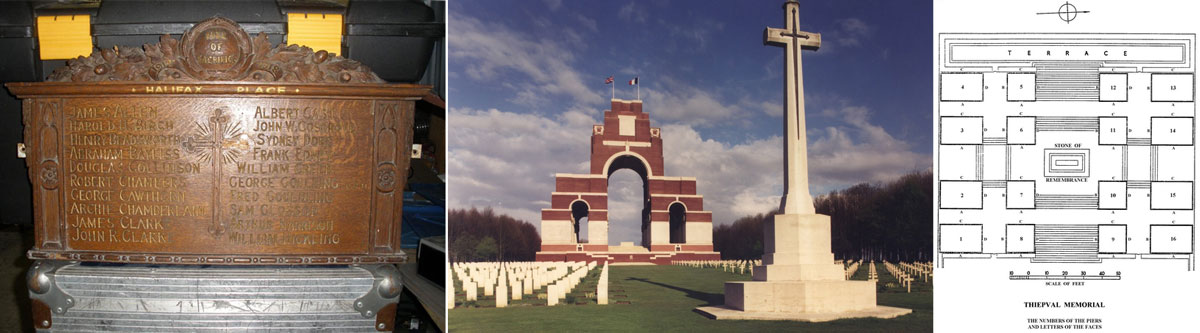
On June 15th 1915 he enlisted with the 1/7th Battalion the Sherwood Foresters (the Nottinghamshire and Derbyshire) Regiment - the same battalion that his brother George had been temporarily associated with. Harry was shipped out to France and saw heavy fighting during the Battle of Loos on the Western Front. In March 1916 they were stationed at Vimy Ridge and then sent south to join the Battle of the Somme on July 1st 1915. An opening attack that day was met with heavy German gunfire and casualties were very high. Harry one of those killed in action and whose body was never recovered. Harry is commemorated on Pier and Face 10C, 10D and 11A of the Thiepval Memorial, Somme, France and on the "Roll of Sacrifice 1914-1918" panels from the now demolished Halifax Place Wesleyan Chapel, Nottingham (24). As recompense Ada received a payment of 1 pound, 7 shillings and 5 pence and a war gratuity of 7 pounds,10 shillings. She married again in 1920 to John Wheelhouse and died in Nottingham in 1957.
Harry and Ada's son Harry married Constance Walker in Nottingham on Boxing Day 1938. Between 1940 amd 1957 they had four daughters (Barbara Freda, 1940; Sandra Joan, 1948, Karen Natalie, 1955 and Vivien Sonia, 1957) and a son (Barry Colin, 1946). At the outbreak of the second World War, Harry enlisted with the Worcestershire Regiment. He was captured at Tobruk in North Africa in June 1942 and was held a prisoner of war until his release in southern Italy in June 1944 (25, 26)
George (1893 - 1970)
Penultimate son George was born on June 26th 1893. After leaving school he entered the lace making industry as a threader. He married Annie Spencer in the winter of 1913. They ultimately had three known sons (George, 1914; William, 1920 and Thomas, 1922). In October 1914 George enlisted with the 2/7th (Reserve) Battalion, the Sherwood Foresters (the Nottinghamshire and Derbyshire) Regiment although he was subsequently transferred as Private 27303 to the Royal Warwickshire Regiment. He served in France from 1916 to early 1919, sustaining a gunshot wound to the shoulder and was also caught in a gas attack. Back home the family settled in Moreland Avenue, not far from the north bank of the River Trent where George became an engine labourer. George died on February 23rd 1970 and was cremated at the Wilford Hill Crematorium four days later. Annie died the following year and was cremated on May 6th 1971.
Frederick (1899 - 1944)
Final son Frederick was born on November 1st 1899. During the first World War he served as a private with the Royal Leicestershire Regiment and then the Royal Lancashire Regiment. He married Sarah Jane Wesson in Nottingham in the spring of 1923. Between 1923 and 1937, Sarah Jane gave birth to thirteen children (9 boys and 4 girls) although sadly five of these died in infancy. At the start of the 1930s, the family were living in Evelyn Yard off Evelyn Street, Sneinton. In October 1932, their seven year old son Frederick was knocked down by a cyclist sustaining a head injury and concussion. He was detained in Nottingham General Hospital for a few days (27). Then, one of their mites, Gordon Charles who was born in December 1936 died one month later. The certificate was signed by W.S. Rothera, the Coronrer for Nottingham after a post mortem examination had concluded that death had been caused by asphyxia due to convulsions. No inquest was required.

Northern Cemetery, Bulwell, Nottingham (28)
Frederick became a railway heavy goods porter and the family lived in Northwood Crescent in the Daybrook Square district of the city. They had seven of their children with them at the outbreak of the second World War. By 1940 they had moved again to Raymede Close in the Bestwood area where Frederick was employed as a railway crane driver. Frederick had become increasingly unwell with abdominal pains and weight loss during the war years. He was admitted to the City Hospital, Nottingham where he died on April 24th 1944, the diagnosis being carcinomatosis with secondaries in the liver. He was buried in the Northern Cemetery, Bulwell, on May 1st 1944. Sarah Jane lived on for another 35 years until she died on June 20th 1979.
Acknowledgements
The authors would like to express their thanks for the help, comments and suggestions from the following in the construction of this article: Contributors to the Nottinghamshire Forum (including CaroleW, Ladyhawk and Mabel Bagshaw) at RootsChat.Com.
Further Reading

1: Cottingham and Middleton, Northamptonshire Soldiers 1914-1918 Christine Blenkarn has developed and devoted a website to honour the men of Cottingham and Middleton who served in the Great War. It notes principally those who were killed in action while doing so (as was the case of Frederick Oliver and Harry Beadsworth) and those who had a much longer military attachment and survived (such as brothers Amos and Thomas Crane). It also looks at the impact on their families and the local community.
Links to the articles mentioned in the text are in italic capitals below:
Article A: Papa Anthony and Mama Priscilla Following the Beadsworth family in Cottingham - Part 1 Arrival
Article B: Gretton people The Gretton Craxfords: Chronicle 1 - The tangled trees
Article C: It all began in Uppingham A history of the Beadsworth family - Part 1: Origins
Article D: Links to Codnor, Derbyshire Unpicking a family conundrum
Article E: The Crane family of Cottingham Part 2: The Younger Generations - Those who left and those who stayed
Article F: Born on the wrong side of the blanket. Mary Ann Crane and her "misbegotten" childrenr
Article G: "I Lift Up My Finger And I Say Tweet Tweet!!" Too many Cooks ... spoil the brats?
Article H: Life on Blind Lane and Barrack Yard We are the Barrack Yard Preservation Society
Article I: To follow
Article J: The short life of Thomas Christopher Claypole Death for threeha'p'orth of suckers
References
1. Family tree graphic: Freeware Graphics: Vintage Kin Design Studio, Australia
2. Photograph of cap badge of the Royal Field Artillery Image public domain Wikimedia Commons
3. Photograph of cap badge of the Royal Warwickshire Regiment Permission for use granted under the terms of the GNU Free Documentation License, version 1.2 from Wikipedia, the free encyclopedia
4. Photograph of: All Saints Church, Polebrook; from an old postcard
5. Photograph: St Michael's Church, Great Oakley © Dave Kelly, on Geograph and licenced for reuse under this Attribution-ShareAlike 2.0 Generic Licence by Creative Commons
6. Photograph of Holy Trinity Church, Anslow, Burton upon Trent, from The Churches of Great Britain and Ireland. Steve Bulman.
7. Photograph of St James the Greater Church, Derby (now closed), in The Churches of Great Britain and Ireland. by Mike Berrell .
8. Photograph of Diamond Street, East Kirkby by Dr J K Slaney in Trajectory part 1: Kirkby in Ashfield, Australian National University, Canberra, Australia
9. Photograph of cap badge of the Labour Corps (The Royal Pioneer Corps) at Wikipedia, The Free Encyclopedia
10. Photograph: St John the Baptist Church, Corby © Ian S, on Geograph and licenced for reuse under this Attribution-ShareAlike 2.0 Generic Licence by Creative Commons
11. Photograph: Cap badge of the Northamptonshire Regiment Dormskirk; Permission for use granted under the terms of the GNU Free Documentation License, version 1.2 from Wikipedia, the free encyclopedia
12. A history of Fort George, India Wikipedia, The Free Encyclopedia
13. Photograph of Fort George, Chennai, India taken by L.vivian.richard and released into the public domain by its author. Wikimedia Commons
14. A Ninian Bruce: The Treatment of Locomotor Ataxia From a paper read in 1927 Reprinted in the Edinburgh Medical Journal in NCBI The National Center for Biotechnology Information
15. Photograph of Fuller Baptist Church, Kettering facebook
16. Boy Killed at Rabbit Shoot: East Kent Gazette Page 2 January 19th 1946 The British Newspaper Archive; © The British Library Board.
17. Photograph of Foundry Yard, Nottingham about 1900: Pinterest
18. Photograph: St Mary the Virgin Church, Nottingham, Corby © Roy Hughes on Geograph and licenced for reuse under this Attribution-ShareAlike 2.0 Generic Licence by Creative Commons
19. The Story of a Blitzed Church: St John's Church, Leenside, Nottingham. Nottingham Journal Page 2 December 27th 1941 The British Newspaper Archive; © The British Library Board.
20. Photograph: St John the Baptist's Leenside, Nottingham in The Scott Dynasty; GilbertScott.org
21. Photograph of Church (Rock) Cemetery, Nottingham by Emma Jolly at deceasedonlineblog.blogspot.com
22. Photograph of Wilford Hill crematorium and graveyard, Nottingham by Simon Annable, Royalty-free stock photograph, Shutterstock
23. Nottingham Lacemaker's Plucky Action: Nottingham Evening Post Page 4 May 28th 1915. The British Newspaper Archive; © The British Library Board.
24. Memorial photographs and location map Nottingham - Halifax Place Weslayan Chapel Roll of Honour - Nottingham County Council
25. More local Men Missing in N. Africa: Nottingham Reservist in Nottingham Journal Page 4 July 21st 1942. The British Newspaper Archive; © The British Library Board.
26. Local War Casualties: Report in Nottingham Evening Post Page 4 The British Newspaper Archive; © The British Library Board.
27. Street Mishap Page 9 Nottingham Journal October 29th 1932 The British Newspaper Archive; © The British Library Board.
28. Photograph of Northern Cemetery, Bulwell, Nottingham by Irish at Find A Grave: Reproduced with permission
Translate this page:



Internet Beacon Diamond Site - 2010
© The Craxford Family Genealogy Magazine and individual copyright holders.Edited and maintained by Alan D. Craxford 2005 - 2026. All rights reserved. Contents may not be reproduced without permission.
You are not authorized to add this page or any images from this page to Ancestry.com (or its subsidiaries) or other fee-paying sites without our express permission and then, if given, only by including our copyright and a URL link to the web site.


 Computers, Poole, Dorset, UK
 UK Web Hosting
